If that (logarithmic) chart starts to flatten - particularly for device #500 (more price sensitive than the first part of the list) on the list, then we're running into real obstacles.
Let's check back in 2020 and see if Device #500 is running at 10 Petaflops.
Most (all?) of those machines are clusters that scale mostly by throwing in nodes. Even if you have completely static technology, you'll see an exponential trend as long as you're scaling with economic growth by adding nodes.
Completely agree with you, which is why system #500 is more interesting than the "Nation State" systems in the first hundred positions or so. System #500 is going to be more closely aligned to the growth in technology.
Also - Economic growth [1] since 2001 has averaged 3.78% /year, for a total of 61% growth in 12 years - if computers had progressed in accordance with economic growth, than I would expect, all else equal, for systems to be .61x more powerful.
In that same period, system #500 went from 100 gigaflops to 100 teraflops, resulting in systems approx 1000x more powerful.
So - I agree that we'll see an exponential trend, regardless of whether technology improves, it's just that the curve is going to flatten (particularly on a log10 scale).
(1) Scaling will be technically feasible for many more years. (Intel's roadmap goes to 5 nm, and researchers have already made transistors as small as 3 nm.)
(2) However, even if scaling is technically feasible, it may not be financially feasible. Quadruple patterning may get you smaller feature sizes, but at a very high cost. The alternative to quadruple patterning, x-ray lithography (called EUV), is also quite expensive, but at least there's some hope that its costs will drop.
(3) Only if scaling is both technically feasible and financially feasible, we will continue to scale. But even then, the benefits of scaling will diminish (as they've been diminishing for years). Traditional scaling hasn't done much for silicon performance in years: recently most improvements in CMOS have come from straining the silicon with germanium. And the other beneficial side of scaling, cost, is also ending. Shrinking transistors gets you more chips per exposure/wafer, but at the same time it raises the costs of each exposure/wafer. We're finally reaching the point now where the increasing costs of each exposure/wafer are matching the savings of scaling.
In light of all this, it's hard for me to see performace per dollar per year (which is not technically Moore's law I grant you) continue at the rapid pace of the past, even if technologies like x-ray lithography, III-V semiconductors, optical interconnects, and whatever end up panning out.
I fully agree. A lot of people say Moore's law is the transistors density doubling every 18 months (or 2 years, it varied). But this misses the economic angle that was present from the start: Moore talked about the density of the least cost process.
So Moore's law stops either when we cannot cram more transistors in a given area, or when we cannot increase density without raising the cost per transistor.
From what I've read I agree it's the economics variant that will end Moore's law. We'll have ways to shrink / increase performance, but not sure if there will be enough market to justify the rising costs.
A lot is riding on the continuation or end of Moore's law, so we should expect a lot of spin on this issue. I note that Intel claims they will decrease the cost per transistor until 10 nm at least, which is not the case for other fabs. But those other fabs are more transparent on costs than Intel, and Intel said they will produce a low cast modem+AP chip at... TSMC. Mmmm...
We have very interesting times ahead of us. Not only in silicon: a lot of progress in all areas was fueled by cheap computing power. A halt in silicon progress would be felt everywhere. Case in point: I'm in telecommunications. Every big steps was enabled by more computation per watt. That's what enabled to move from single channel TDM to CDMA to OFDMA with wider bands. If we can't increase exponentially the amount of computation per watt, then don't expect an exponential increase in wireless throughput either. It will progress, as everything, but at a slower pace.
The end of Moore's law will probably come at about the same time true human-like AI appears. i.e. It seems like it will always be just a few decades in the future. e.g. Here's an economist article (sadly, paywalled) predicting that the end was nigh in 1995!
If you extrapolate current designs out then, yes, a size barrier is approaching. So, we should expect new designs to start appearing. For example, non-planar designs offer a lot of potential to reduce average trace-length, which could reduce power dissipation and increase speeds in turn. There are huge challenges to solve, but it is reasonable to expect that they will be met so long as the demand is there. In this light, Moore's law is almost a self-fulfilling prophecy. The demand for computational resources grows exponentially, so a way to meet that demand is always found.
Just because people were wrong in the past, doesn't mean that people are wrong now. This time, I really do think it's different.
Historically, scaling provided a few benefits. As transistors got smaller, they went faster and used less power. They also got cheaper. The first benefit, going faster and more efficient dried up back in the early 2000s when leakage currents because a problem. This is why transistors have been stuck at 3 GHz for so long. The second benefit, cost reduction, is now disappearing. The cost per transistor actually went up with the last node! These days, lithography costs dominate all else. The only way for chips to start getting cheaper is if EUV pans out (so far it's not looking great, but we'll see) or if we radically change the fabrication process and turn transistors sideways (this requires extreme etch control).
Even if it is technically feasible to go smaller, unless EUV costs go down it may not be financially feasible.
Moores law is not a physical law. In fact the laws of physics dictates that it can't possibly be going on forever, as there is theoretical limits for how small and fast you can go. Then you can go some more years playing the "cheap" card but even that have to end eventually. The question is when. What is amazing is that it have been allowed to be in effect for nearly 70 years, and still no signs that it have stopped.
Hopefully the end of cost-effective process shrinks will mean programmers start cleaning up the mess of hugely inefficient everyday software.
The party may be winding down for full x86-64 cores, but there's still some room for improvement by increasing efficiency of instructions on those cores and adding new instructions for common tasks (like hashing acceleration instructions, sse9000, etc). Intel already does that with each new processor family.
There's a large one-time improvement available for computation-heavy workloads by integrating many simpler high-performance low-power cores into everyday machines (like the epiphany architecture: http://www.adapteva.com/). Intel seems to think only servers will go that route (Xeon Phi), but I don't know about that.
> start cleaning up the mess of hugely inefficient everyday software
I kind of wish for it too. Mainly because it's so enjoyable and fun to spend hours on really groking the code and optimizing it instead of duct taping another feature at the top of similarly messy pile of other features.
Things like Go, D, Nimrod, Felix, OCaml and Haskell could help too.
That said I don't see this happening in the near future: for business side of things optimization starts to matter when it's too late to change technology. What's probably going to happen is one-click, transparent (for the application logic) clusters, where performance issues are solved by adding nodes. It happens right now with AWS and others, but it will be much easier and better in the future, once again making optimization not needed. For a while.
His future predictions can be fanciful, but his data from the past is solid. He thinks it could be nanotubes next. But it seems fair to say it could be as surprising to us as vacuum tubes were to people using relays...
I wonder what the post-Moore's law world will look like.
The past couple centuries has been dominated by consumers and businesses automating and digitizing increasing parts of their lives as computers become more capable to handle them at the same low cost. (And the power the Internet gives us for being able to share information)
As creating faster chips becomes harder, institutions will start to invest more in other promising fields and technologies. I wonder if the next few decades will be dominated with developments from an entirely new discipline and culture.
?? Centuries? You mean twenty/thirty years, probably? We don't really have computers until about 50 years ago, and even then it was not widespread.
You don't have to wonder what post-Moore's law will look like. Look at other industries when they become mature. The car industry is one example: there's not that much innovation that goes into making a car better in terms of performance. I mean, a car from 30 years ago may be less comfortable but still drives pretty well as long as it's maintained. What makes the difference then is not performance anymore but whatever added value you bring on it: durability, reliability, service, etc... no doubt sooner or later electronics makers will have to innovate in different directions as well.
Cars are miles ahead of where they were in 1983 (pardon the pun). Compare everything from a family sedan to a sports car of the current era to then. Tires, creature comforts, horsepower, emissions, fuel economy, safety...
The comparison is moot. You can't drive 100 times faster with a car from 2013 than from 1983. With computers, you saw that huge progression in a matter of 10 years. Now what you have in your pocket is close to what used to run servers 10 years ago in terms of power (or maybe exceeds it). If at all, your argument strengthens my point that cars have stopped evolving in performance and now car manufacturers work on other attributes.
I suspect that though size and speed may not increase, costs will likely continue to fall for at least a while. This will affect what sorts of systems can be computerized and at what cost, if not the computational power of those devices.
And while I've been watching promises of quantum computing for a decade or more with no apparent real progress, it's possible that alternative models of computing devices will allow still greater computational power.
I think it's already plainly visible : since the only way to get more and better performance and features will be large compute farms, the entry-fee for IT related stuff will raise because you need to invest in a horizontally scaled entire data center, instead of just a few computers.
I'd also expect more of EC2 and GCE to happen, and ironically the "small" developer to pay less, but also have less options.
The suit is back! Seeing this exact headline about a blowout sale all over the web[1] at once, reminds me once again of paul graham's submarine - http://www.paulgraham.com/submarine.html
> After another three generations or so, chips will probably reach 5nm, and at that point there will be only 10 atoms from the beginning to the end of each transistor gate, he said. Beyond that, further advances may be impossible. "You can't build a transistor with one atom," Samueli said.
I don't get it - did people assume that chips could get infinitely small?
Seems pretty obvious that Moore's Law would fail at some point.
Disclaimer: I didn't know about this law before today so I'm probably ignorant of something.
Anyone with knowledge of transistors knows that transistors cannot scale forever. I imagine this point is emphasized for people who know nothing about transistors except their amazing history of scaling.
Can somebody explain how and why this will hurt consumers like me? As long as I can still buy some general purpose computing device with 2013 desktop performance that I can plug a screen and keyboard into and run/write software the end of the upgrade treadmill seems pretty welcome. Am I missing something?
Yes - that the progress so far has allowed other form factors like smartphones. If it continues, it may open up new possibilities as well that wouldn't be feasible with the current level of chip technology.
So my loss is that I won't be able to buy hypothetical new devices that I don't currently know I need. This seems more like a problem for manufacturers than for me.
I don't see this as a major problem since my nearly 4 year old computer is still working fine for most of my computing needs. Computer chips are so powerful now that they don't use a lot more than older computers didn't use.
Hmm, consider that you haven't spent any money on a computer in 4 years. Look at the 'health' of the computer companies like HP, Dell, Acer, etc.
The problem here is a bit more insidious than you might assume at first glance. The reason you can buy a motherboard for $100 which has close to a thousand individual components soldered to a 16 layer board is because a manufacturer invested tens of millions of dollars in a highly automated manufacturing line that could turn out millions of them a month, and all the connectors on them had injection molds made because billions of connectors would be needed, and testing companies built amazing bed-of-nails testers that can run 25,000 tests on that board.
When I was at NetApp our partners built systems for us (so called ODMs) to our specifications but in the thousands, not the millions, and our motherboards that had a similar complexity to the ones that Gigabyte or ASUSTek could sell cost us $800 each. Smaller runs, those in the hundreds, are like $2,500 to $3,000 each.
The lack of buying is taking the oxygen out of the system. These guys are cutting costs where they can, but there will come a time in your lifetime where buying a cost effecting "PC" class machine out of parts will be very very hard to do, they just won't have the volume. A new TV with similar smarts? Still cheap. But a desktop machine?
They call them economies of scale, when there is a scale, when there isn't they don't work so well. Factories in China are starting to switch over to making systems for server farms, not individuals. Amazon, Google, Microsoft might by 50,000 at a time. You and I, not so much.
We are on the leading edge of that change. I have a sense that it is going to be a fairly dramatic change.
>The lack of buying is taking the oxygen out of the system. These guys are cutting costs where they can, but there will come a time in your lifetime where buying a cost effecting "PC" class machine out of parts will be very very hard to do, they just won't have the volume. A new TV with similar smarts? Still cheap. But a desktop machine?
Servers have been moving in the other direction all my life, becoming more and more like your commodity desktop. My dad worked with mainframes; when I came of age, SUN sparc was still a thing. As far as I can tell, as time goes on, the server stuff starts looking more and more like the consumer stuff.
Hell, half the low-end server stuff these days has a built-in APU, and there's a lot of discussion on how we server types can use that.
That said, yeah, if you doomers are right and people stop buying desktops all-together, your 3x-4x estimate on cost multipliers /for the motherboard/ isn't unreasonable.
Personally? I think the reason why old computers work fine right now is that everyone who used to spend effort writing new software to make your PC seem slow is now writing new software to make your cellphone seem slow. The thing is? I think this will pass. This is the first wave of "wow, pocket computers are actually useful!" which is cool and all, but I think that we're approaching the point where we are going to run up against the fundamental limitations of the form factor.
But yeah, that's the thing; until someone gets around to writing new software that makes your PC seem slow... PC makers are going to hurt.
However, look at the direction desktop hardware is going. Integration of more and more functionality into SoCs is the future for non-high performance desktop computing.
The more components that are integrated into the chip, the less there needs to be on the motherboard. Even better, all the high speed stuff can move onto the chip, making motherboard design easier. How long until SoCs come with RAM on die? Could you get away with a 4 layer motherboard in that case? So whilst you may lose economy of scale on the motherboard side, I think you will gain it back via integration, however, you will lose the ability to customise.
> So whilst you may lose economy of scale on the motherboard side, I think you will gain it back via integration, however, you will lose the ability to customise.
True but if the SoC was advanced enough it can make customization unnecessary. After all a phone or tablet or laptop or a desktop or a server is just a computer with some processing power and memory. Old super computers can now fit on a Samsung Galaxy Gear. Add more of the same to the SoC or make SoCs of varying specs. Who needs customization in such an environment.
PCs still sell by the truckload. There are developing markets as well where expansion is still possible. There's the PC gamer market, which will probably expand with SteamOS's initiative. Who knows what the market will be like 10 years down the road, but at this point, we are far from being at the edge.


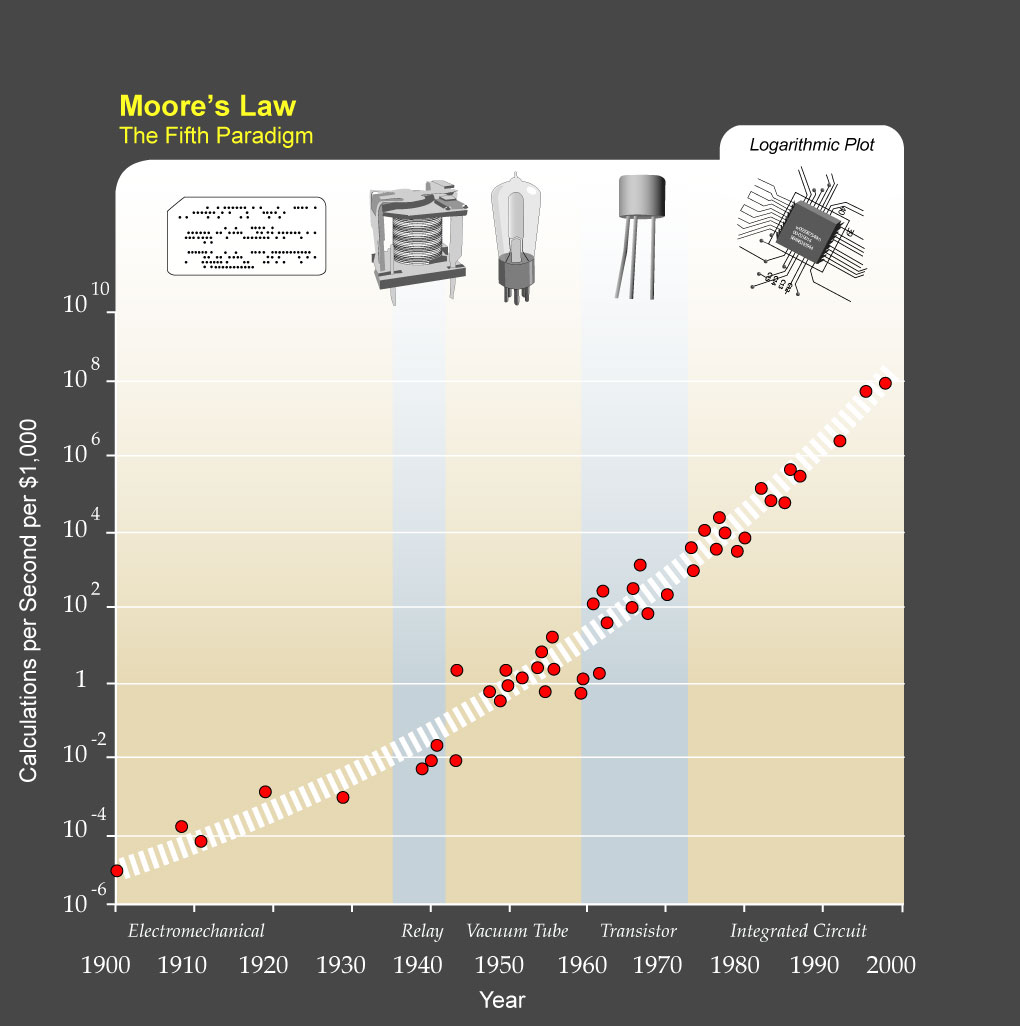
If that (logarithmic) chart starts to flatten - particularly for device #500 (more price sensitive than the first part of the list) on the list, then we're running into real obstacles.
Let's check back in 2020 and see if Device #500 is running at 10 Petaflops.