I lived in Los Alamos for a while. I looked into renting a studio space. I became curious about the property across the street from my prospective rental which was surrounded by a chain link fence with green canvas. I researched and learned it was the site of an original Manhattan site waste dump which had, a few years prior, been enclosed with a negative pressure tent and cleaned up at a cost of 2-3 billion. Apparently the government had dumped an unknown quantity of high level nuclear waste there in an unlined pit in the dirt in the 40s. This led me to research the history of the area.
After a couple of months I figured out that my house in White Rock was about 3/4 of a mile from the current waste dump for the entire lab, known as TA-53 or MDA-C or something. They were in the process of excavating the three 200 foot deep pits of MDA-C - one for low level nuclear waste, one for transuranic (as they call “high level” these days) and one for classified waste. If I stood on my roof I could see the negative pressure tents surrounding them. My favorite non-classified project which was disposed of there was the “experimental high temperature plutonium reactor”, from the 90s.
The lab has some rather interesting history. There was no concept at all of safely disposing of anything or even recording what they dumped and where until the 60s. The first ever radioactive metal working facility, out on a ridge by the entrance to town (TA 21? 23?) dumped all of their wastewater directly into the canyon untreated. This has recently been cleaned up at a cost of several billion dollars also, and now they are building homes there. The heavy/radioactive metal plumes went down into the earth over 500 feet. In fact, all of the waste from the entire lab used to be dumped into a stream in the middle of town. They cleaned it up, opened it as a park (“Acid Canyon”), then after heavy rains found some barrels they missed which were determined to contain plutonium waste. Oops, cleaned that up some more and now it’s a nature preserve and hiking area. There are still untouched facilities from the 50s where Feynman worked on polonium experiments sitting a few hundred feet from the banks of the Rio Grande.
There was a power plant right on the edge of a native reservation neighboring the lab. According to the federal government, the plume of chromium contamination it left ends exactly on the property line of the lab to the reservation.
Everyone I met in Los Alamos had zero concerns about pollution having an impact on them.
Fun fact, if you ever want to locate sketchy sites, the keyword is "Wildlife Management Area". Odds are pretty good it's going to be some former superfund, government, chemical, or industrial cleanup site. They do their best to clean up what they can and then declare it a nature preserve.
It's nuts that this is a legal practice. It's intentionally deceptive to the general public and also removes peoples right to avoid exposure to bad stuff in bad places. There should be some kind of law passed that at least forces these places to be labeled what they really are. This quote about the former Rocky Flats that has become a nature preserve sums it up:
"The area is an industrial nuclear waste site, not a nature preserve. If you want to learn about prairies and wildlife, there are plenty of other non-contaminated areas in Colorado to visit and learn."
It's a nuanced question, given the fact that toxicity depends on many characteristics: method of exposure, dose to body weight, bioaccumulation, etc.
For a substance that needs to be ingested in high doses for an average human (even a small child) over an extended period of time, what's the harm of having a contaminated park?
You have relatively infrequent exposure, and you likely don't eat / drink from the area. That's a helluva lot safer than living in a "less-polluted" industrial site, but where you could build up toxic exposure over time.
> For a substance that needs to be ingested in high doses for an average human (even a small child) over an extended period of time, what's the harm of having a contaminated park? You have relatively infrequent exposure, and you likely don't eat / drink from the area
Based on my experiences with how our children behave when they're playing in parks, I much prefer the thought of parks not being contaminated!
Small kids typically come home from parks dirty. Heck, small kids come away from pretty much anything dirty :)
One of the geologists who used to work on that "clean up" project mentioned that the lines on the map of what was clean, what was still contaminated and how badly radioactive plumes spread were all drawn by politicians. Not by engineers, scientists or technicians.
Is it done so people will/can not settle there legally? Thers a large waste dump near me and its actually closed and defined as nature reserve and thus people are prohibited to live there.
> Everyone I met in Los Alamos had zero concerns about pollution having an impact on them.
I mean, are they wrong? By all conventional metrics, Los Alamos County is one of the healthiest counties in the country. Obviously there are major confounders, but if it doesn’t readily show in the data maybe zero concern is the right level.
I found it somewhat reassuring, as these were people trained in nuclear science, invested in the area and raising families there. However, they're not ecologists or doctors, and are basically the successors of the people who randomly dumped a bunch of nuclear waste all over. I'm sure if you asked in the 50s they would have told you oh yeah, it's fine, it's under 30 feet of dirt.
I asked one nuclear chemist what he thought about the new housing developments at TA-21 (or whatever it is), the site of the milling facility. He said "Sure, I'd live there. Well, I'd take my geiger counter".
Los Alamos is higher elevation than surrounding areas, on top of sandy soil that drains to the Rio Grande. I'd be more concerned about the health impacts on the people in the watershed. Los Alamos County has one of the highest per capita incomes and education levels in the country (I believe it has the highest percentage of PhDs), and pretty much everyone there works for the Labs, either as scientists or support staff. I'd me more concerned about the health impact on neighboring communities such as San Ildefonso Pueblo, which is quite the opposite - one of the lowest income and education levels in the country. Santa Fe is also a short distance down the river. The reservations there have indeed raised concerns about the impact of pollution on them, such as the aforementioned battle over chromium contamination.
They are also typically more highly educated and more well off. After all, it is a town settled by scientists. These types of towns typically are outliers under a lot of metrics.
Where I am, developments are constantly built on old landfill, including landfill used for industrial waste. People buy in and then are shocked 5-10 years down the line when they find out their soil is contaminated and they can't eat what they grow in their gardens.
That, and the developments that get built near Superfund sites or old industrial sites. Most of a nearby town's residential areas were built on property that once had Industrial Revolution-era refineries and mills on them, back when waste was regularly just buried or dumped in streams and rivers. To this day you're warned not to eat shellfish and fish caught in the bay because of heavy metal contamination from that era. Tons of people still eat them anyway.
Can't say I'm surprised to learn that the same mindset gets applied to old nuclear waste dumps, too.
There is a development on treasure island in the sf bay in which your not even technically supposed to dig in your yard at all, for any reason, or risk being exposed to too much of whatever they left there.
"Whatever they left there" is the most terrifying part of a lot of these long term sites.
Without documentation, and as GP mentioned, you can scour the site as much as you want... and easily miss a single buried barrel of god-knows-what, that only the guy who tossed it off the truck knows was there (if even they knew), until it finally rusts through or is punctured.
Ironically, leaking or unsealed waste sites are probably safer, because it pervades the environment, is more easily detectable, and doesn't have sudden failure modes.
This sounds like the same story as Rocky Flats west of Denver. Same thing, after "Cleanup" it's a (still radioactive) nature preserve and housing development now.
Pu in soil within the Rocky Flats National Wildlife Refuge contributes (NIST soil standard data) about 0.8% of total soil radioactivity. Remembering that 239Pu emits almost no gamma rays, it's no surprise that annual doses from soil inhalation plus ingestion give 50 year doses of less than 0.1 milliSievert. By contrast, ANNUAL doses from background radiation around RF are about 1850 times larger, and a chest X-ray is about 25 milliSieverts. Scope out rockyflatsneighbors.org for actual reliable Rocky Flats data. Former Rocky Flats workers contributed more than any other non-Soviet group to knowledge of biological effects of Pu on humans.
Yes. Thanks. The link below has the most up to date comprehensive diagram of typical doses. For the uninitiated: the 'relative biological effectiveness' of photons (X rays, gamma rays) is typically taken to be one; by contrast, for alpha particles it is generally taken to be 20 since they dump much more energy per unit path length than do photons.
That's smaller than the difference between nearby towns far from nuclear power plants. Its not something even worth the mental space to think about when deciding where to move to.
A very slightly worse school will likely have a much bigger effect on your kids life expectancy.
Do you have evidence of this? I’ve looked into Rocky Flats specifically because I live in the area, and I can’t find any evidence that radiation levels are dangerous.
I was about to mention Rocky Flats. It’s very easy to find the published evidence. This is from the EPA and mentions what was not cleaned up (of course that says it is safe):
But I would not believe that’s full disclosure. The EPA has a vested interest in finalizing superfund cleanups successfully. As far as I know, there is no oversight or third party auditing.
discusses the surface and groundwater monitoring of the downgradient plume samples and flowcharts the technical evaluation process without (that I saw on a cursory glance through) providing the raw data.
You should be able to request the raw data (Government data, freedom of infomation, etc) and chase up what it means or ask around your nearest university | friend in radiology | medicine, etc.
Not all 'radiation' is harmful, it has to be either ingested (and strong enough | toxic enough to cause health issues) or rise in concentration (outgassing of radon | other gases into enclosed basement spaces.
Currently they are monitoring the traces in downstream groundwater and staing that radiological isotopes are present (as expected) but ever downgrading (as they do).
Judgement of personal risk in that area should be made on the basis of degree of exposure to the area groundwater and its current state as time goes on.
My issue with it is captured in this quote from the website candelisglows.com:
"The area is an industrial nuclear waste site, not a nature preserve. If you want to learn about prairies and wildlife, there are plenty of other non-contaminated areas in Colorado to visit and learn."
My opinion is that they are intentionally deceiving the unwitting public when they call a place like this a nature preserve and put trails on it. If it was called so and so former nuclear waste site people would make the decision to hike elsewhere. Just call it what it is, fence it off from the public, and move on. Same with the neighborhood.
Call it what it is, sure .. but why "fence it off"?
The surface layers down for a few feet are highly unlikely to have any waste (assuming the US can do a rehab properly) and the actual radiation risk is likely to be far far less than hiking in totally "natural" granite ridges where radon gases pool daily until breezes clear them out.
My point is that we had a fenced off area where they did a bunch of bad stuff, leaked open containers of radioactive waste were left open and leaking for decades. We then went in, removed the top 3 feet of soil and replaced it with fill, and then removed the fences put trails all around and signs and advertising to call it a nature preserve. I argue that every action after and including the removal of the fencing wasn't value add to our society as a whole and shouldn't have been done. Clean it up, leave it fenced off and leave it called what it is, a nuclear waste dump that was partially cleaned up.
I’m not sure if this is a helpful comment. Yeah the dose matters. Do you have any numbers on the contamination levels of this site?
Groundwater/soil contamination is notoriously hard to measure and the variance can be much bigger than the average. Given this history of government obfuscation around this issue, would you even trust their numbers? The concern is based on risk which needs to factor in more than the latest government estimate.
I'm assuming you're assuming the linear no threshold model here otherwise this statement doesn't make sense.
What do you mean by "dangerous"? Because having sex with your wife is dangerous in that it increases the risk of heart attack. Some dangers are negligible increases that are worth the risk. A 0.00001% increased risk of lung cancer is negligible compared to things like air pollution from living in a city.
Radioactive metals are heavy metals, and uranium for instance, even without the radioactivity, is dangerous in the same way as lead. It's definitely not something you want in your water.
They detected plutonium in the water supply of Santa Fe in the 70s and according to this article, as recently as 2006. The ideal quantity of plutonium in your water is zero.
It's similar. There are many sites around the country that contributed to nuclear weapons development back then and have been left with pollution problems. Hanford, for instance, up the river from Portland, is a fair bit of a disaster.
I wonder why they didn't travel further to dump it. The ocean in particular was a popular dumping ground in Europe after world war 2 for anything toxic related to the war. Old warships was loaded to max and intentionally moved and then sunk in an undocumented regions in order to make sure that no one could recover it.
Los Alamos is a long way from any ocean. The amount of security needed to haul this stuff outside the secret city (at that time) would have been prohibitively expensive and a distraction from the mission.
In later years when the city was no longer secret, the excuse was mostly the lazy one of "we've always done it this way."
When I was in college, myself and a few friends briefly passed through Los Alamos on our way to the Grand Canyon. The thing I still remember (it was a while ago) was seeing a sign on the laboratory grounds saying, “dirt removal from canyon prohibited”.
I drove through Los Alamos in the mid-1990s. It's an incredibly beautiful area, great topography dotted with such charming pre-kitschy neighborhoods and neato futuresce 1950's homes. Am I going to be ok?
Northern NM in general is fantastic. If in Los Alamos I definitely suggest the drive west of town past the Valle Grande, which ends up going through Jemez Canyon and wrapping up to Zia Pueblo NE of Rio Rancho. Bandolier is definitely worth a visit as well. Also, just about any way you can get to Taos from Santa Fe or Los Alamos is highly scenic.
I feel like they pretty much have it under control at this point, though there is always the danger of an accident. If I had ot go live there again I would probably not live 3/4 of a mile from their 63 acre toxic waste dump. The more I read about the history and current status, the more concerning it was. While I lived there incidents occurred like accidental release of radioactive gases and organic compounds.
Another fun thing, the open hiking area by my house had a sign warning that one might encounter one of dozens of types of undetonated ordinance from the 50s and 60s when they used it as a test bombing range.
There were many very healthy looking elderly people walking around the neighborhood each day, so it can't be that deadly. I actually became very ill while living there (I developed adult onset type 1 diabetes), but I don't believe it had anything to do with the area.
They keep saying that profit seeking was the issue, but taking selfies with plutonium, running a lab for 4 years that produces nothing, and not having any employees that don't understand the most basics of nuclear physics does not sound like profit seeking. It sounds like someone just has way too much money and runs a nuclear weapons lab as vanity project.
If you continued to read the article, you'd see that there was a culture of throwing caution to the wind to increase productivity at not only that lab, but other nuclear facilities around the world.
Hell, the article even went on to say that workers at the facility even came up with a euphemism for orders that ignored basic safety protocols, they called them "Bubba said" orders.
And the article said that after those criticality events, those in charge of the facility and safety of personnel just had people keep working instead of evacuating.
This type of thing is common in all industries - so much so that one way that railroad workers would strike is to “work to rule” - follow every single safety regulation to a T causing productivity to plummet.
Many safety rules can be summed up as “don’t be a dumbass” but trying to proceduralize that can be difficult.
It’s part of the reason nuclear stuff is so expensive - you have to work to rule every single time.
Indeed, if memory serves, the incident I mentioned above was somewhat attributed to an old rubber buffer that was supposed to be pressed against the ICBM - by regulation, it should have been replaced due to age but wasn't, and it was dry and cracked so it did not form a good seal which allowed the socket to fall through. That failure to follow regulation caused the (non-nuclear) explosion of an ICBM, killed a person and injured others, and nearly caused a nuclear explosion on US soil. I suppose it should be expensive.
The lab that quip was from is managed and operated by for-profit contractors. I believe the intent was to relate how common it is to make safety shortcuts to boost productivity.
With that said, I'm not sure it call all be attributed to a profit motive. The article also states that this lab was historically the best funded and generally considered above scrutiny, which led to a culture of arrogance.
> And the article said that after those criticality events, those in charge of the facility and safety of personnel just had people keep working instead of evacuating.
And how exactly did they convince those employees to keep working? The employees are not making extra for not following rules, do people really just not care about their lives?
(I don't for a second believe someone working in a nuclear lab would be unaware of criticality, so ignorance can't be the explanation.)
I didn’t for a second believe someone working in a nuclear lab would have brought together that many high purity plutonium rods in close proximity, but apparently I was wrong.
There is a very gung ho culture in labs about safety. It slows you down to do things right and when it comes to reviews the cowboys (and girls) who do things wrong but fast get better reviews because they get more done.
Nuclear labs kill the people inside them at worst. Bio labs ... Well there's a reason why I think covid was the worst lab accident in human history.
I’m not sure why you’ve been downvoted but this is a very prevalent attitude at hazardous facilities that are run by contractors. In particular, when the hazards are relatively low probability events and there are perverse incentives to roll the dice in the name of productivity.
In a previous job in a hazardous facility, I’ve had very senior managers sit me down to tell me I don’t want to get the reputation for slowing things down by enforcing safety rules. I’m personally glad I’ve moved on with my career.
I think this is universal. The safety rules go so overboard that the critical ones get ignored with the stupid ones because employees don’t know which ones are the important ones. If everything is critical nothing is
My first job out of highschool: overnight loader/stocker at a hardware store.
The guy who ran the big forklift in the lumber section was a bit of a cowboy. At the start of the night there would be a big pile of lumber, and he had to sort it and get it on the shelves. We couldn’t really run two lifts at the same time due to aisle width, so he did the job solo, and ran the equipment fast to get it done in time.
Start of shift one evening an upper manager came down and said they reviewed security camera footage, that he was driving too fast, and needed to be more careful. But how do I get it done in time, he said? She emitted the verbal equivalent of a shrug, and left.
Because, of course, she doesn’t want him to be slower, she wanted him to be more careful. To be on record as having issued a warning, so that if something happened, her ass would be covered. She couldn’t solve the problem but she could certainly apportion blame beforehand.
Yeah, that's more of a CYA than an actual strong safety culture. It's more safety theater than anything else. I've had plenty of similar instances, where managers were allowed to get rid of safety/quality requirements as long as they formally documented that they understood and accepted the risks. They almost were never willing to do so, but would still pressure their employees to, you know, find some other way to get the work done faster.
This is major issue in my experience. Even introducing new benign chemicals can lead to lengthy reviews and project delays. I've also found that when I've asked directly how to safely handle something the safety people don't have an answer and end up with an extremely conservative approach that doesn't appear to be driven by actual risks (severity or probability).
This is very true. At a certain point, management needs to be willing to prioritize what safety requirements they are willing to endorse. The worst of both worlds is when leadership isn't willing to formally do so, but push an informal culture to ignore safety rules.
It’s worse when it’s low probability but high severity risks. Sometimes something that is critical but low probability is more easily conflated with not being a legitimate risk. I dog think it’s telling that the article made it seem like the entire safety team quit en-masse
Counterpoint is that it's easy to dismiss a requirement when one doesn't fully understand it. Sometimes that takes less work to dismiss it rather than spending the effort to remove one's ignorance. Particularly in safety critical systems, it's probably prudent to assume there is a good intent first.
A classic one for home food preserving - some of the old recipes have steps that ‘don’t make sense’ but are crucial to food safety. Without them you might get botulism.
Conspiracy to cover up a mistake, maybe. There's no way to know, but given what is known about the origin of covid it's too plausible to just dismiss. We'll just have to live with the ambiguity.
In addition to what you said (conflating lab leak with various things), there's another factor: Early on, the people who were funding the gain-of-function research at WIV put out a statement that considering possibility of lab leak == racism, and some people are still following those orders.
There is no proof that it was or was not a lab leak, engineered or not, intentional or not. Whatever evidence there was has been destroyed.
I'm certainly not putting words in your mouth. You asked why you were being downvoted. I mentioned that there's a conspiracy theory along the lines of what you're saying. In no way did I say, "YOU'RE propagating a conspiracy theory". Just that there is a thing, and that thing is in some way influencing people's opinion on your comment. That does not imply intent.
That the governments have tried to make appear the theory of a lab leak, contrary to expert opinion, as "exceedingly unlikely" is now a conspiracy fact, not theory.
If you want some theory, then : The Wuhan Virology Institute database has been taken offline in September 2019. And investment was made in aeration systems. French intelligence agencies have been mandated to investigate in autumn 2019. (The October 2019 Wuhan military sports games would have been a good occasion.) Then, in January 2020, the passengers list for a military plane from Wuhan to France didn't match.
Those are facts too, the theory part is the way I put them together. (Could have been a coincidence of course.)
P.S.: Also relevant to the article here is the relationship between the French nuclear program and the Wuhan lab. (Both need pretty extreme safety, so I guess it's not surprising how the know-how from the former resulted in the latter !)
> Well there's a reason why I think covid was the worst lab accident in human history.
And that reason likely has to do more with the fact that you're not a virologist nor someone who has a deep understanding of virus evolution and how Sars-CoV2 does what it does.
If there's a big explosion in Los Alamos I'm going to think it's a nuclear explosion even if everyone else says it's a meteor. Balance of probability is that the biological weapons lab was doing biological weapons research and it got out.
Without a non virologist investigating what happened there this is the same level of believability as cops clearing themselves of wrong doing in an afternoon.
The probability of a nuclear explosion at Los Alamos is vanishingly close to zero for lots of reasons. The probability of a nuclear accident at Los Alamos is pretty much 1.0, since several have happened there before, and recently.
> do people really just not care about their lives?
Nuclear in general is very over regulated and over safety conscious. This leads to many pointless or overly cautious rules, which slow things down and lead to people ignoring ALL the rules, including th important ones.
In the article, it looks like the public workers before the buyout were also careless so it sounds like people who work around dangerous plutonium just become careless over time.
> Virtually all of the Los Alamos engineers tasked with keeping workers safe from criticality incidents decided to quit, having become frustrated by the sloppy work demonstrated by the 2011 event and what they considered the lab management's callousness about nuclear risks and its desire to put its own profits above safety.
> When this exodus was in turn noticed in Washington, officials there concluded the privately-run lab was not adequately protecting its workers from a radiation disaster.
Putting a profit motive anywhere near anything that is safety critical is almost never a good idea.
Naval Nuclear Power has it's issues, yet it is so safe that we have almost no incidents. That's because things like this don't happen there due to the culture of safety.
That said, this is about production rather than operation, but the overall communities are relatively small and aligned.
It’s hard to do a direct comparison as government jobs tend to inherently be more risky and accident reporting rates vary. An Air Force pilot isn’t directly analogous to an airline pilot nor is a police officer even vaguely equivalent to private security.
Private sector hospitals, which are arguably the closest direct analog with public sector counterparts, have higher rates of workplace injury than public sector hospitals. By comparison private teachers have lower rates, but work with less at risk populations etc.
PS: Reports of illness are noticeably higher in the public sector, but that likely relates to differences in PTO etc.
I was more thinking of industrial accidents, for example.
In any case, when given the right incentives, profit seeking companies are excellent at promoting safety.
Similarly, bureaucrats working for organisations without a profit-motive don't magically follow the same preferences we might dream up in our armchairs. They also need to be given the right incentives.
If anything public sector industries are far far larger in terms of scale, so it's likely that 1 single public disaster trumps many private ones. However, private sector has shown time and time again that it can create huge issues, for example take the forever chemicals inside you right now that you didn't consent to having inside you.
I want to believe private and corporate is better. It's hard for me.
It seems theoretically sound: the profitably threshold for accidents is lower than the threshold most people are comfortable risking their lives for a job for, so a for-profit company is pressured to lower standards to the most profitable level (eg having people continue to work around a safety accident).
You can always ensure the profitable accident level stays above this with steeper penalties from regulation though.
I think the idea is that a for-profit motive forces you to choose "cheap". And if your contract has productivity targets, it constrains you to also select "fast".
These types of contracts are often selected for lowest bidder. I know of one such example where the contractor was pressed during the bid process about how they could be so competitive with their quote. The retort was to the effect of "Our secret is we do more with less." Unless there really is a vast difference in capability of the competing contractors, this naturally puts downward pressure on just doing less (in the form of following certain requirements).
Agreed. But "going to bid" will almost certainly constrain to a profit motive.
Even if there was a case where a bidder is non-profit, I can't fathom how they would bid on a project with the intent to be in the red. Maybe there are more exotic ways to run a lab, but it seems like the choice is to either figure out how to work with a profit motive or be a primarily civil servant lab.
The govt can sometimes try a "best value" award instead of low bidder, but that tends to make lawyers skittish because it opens up avenues for the losing bidders to protest the award.
Do you have a proposed solution? How would one mitigate the "low bid" incentive?
My experience is that it creates an incentive to often create excessively low bids (to the point of not being profitable) in order to ensure a company gets a contract. And then ensure their "budget/profit" is made up by either a) cutting corners to reduce overhead or b) making change orders to increase revenue.
One solution is additional oversight, but it's not clear to me that is a feasible option.
I suspect the navy gets away with really riding peoples asses on safety - and developing protocols and procedures and equipment that are “military grade” meaning a drunk monkey with a sledgehammer could operate it successfully.
Designing things that verify previous steps before acting on the next step is a great way to do it.
"In 2005, shortly before the profit-making firms wrested majority control of the laboratory from the University of California, the lab's "nuclear criticality safety program did not meet many of the" nuclear industry's standards, according to a DOE report in 2008."
The lab just doesn't have a culture of safety, it has nothing to do with profit. The profit motive was mentioned in the Japanese lab, not Los Alamos.
It’s possible it isn’t quite so easy to parse the profit motive in that manner.
For example, I worked in a not-for-profit research facility. The top line managers were govt but the vast majority of workers were for-profit contractors. There was about a 9:1 contractor to civil servant ratio. On paper, it was a govt run facility but in practice, the for-profit culture dominated.
The photo didn't shut things down. A culture of disregard for safety over years, and a failure by management to take the issue seriously, shut down the lab.
I admit it's alluring. It's just a chunk of greyish metal, how dangerous could it be?
Radioactivity is already a mysterious and fascinating and alluring phenomenon, and somehow radioactive things not looking particularly dangerous only adds to that effect.
There's something strange about ionizing radiation: it's extremely dangerous, yet we have never evolved the ability to detect it and have no intuition for it.
Hasn't there always been a risk of radon appearing in basements and groundwater?
Regardless, it's clear that radiation was not enough of an evolutionary "problem" for our bodies to evolve to cope with it, beyond whatever we get from the sun. But that's just the thing! We are so used to our bodies mostly doing the right thing in response to various dangers: bitter is poison, cold is frostbite/hypothermia, burning pain is fire/burns, nausea/disgust is disease, thirst is dehydration, etc.
Ionizing radiation is weird because it literally destroys our tissues, but does so indirectly by destroying our DNA (as far as I understand anyway), but we never had any evolutionary reason to be able to "feel" our DNA being destroyed, so we evolved neither the ability to detect it happening nor the ability to see or detect radiation in the environment.
I suspect that many industrial chemicals and poisons in a similar category, e.g. many poisons are either neutral or sweet-smelling/tasting. But radiation is especially weird and scary because it's such an unfamiliar phenomenon to begin with, unlike poison which most humans seems to understand instinctively.
There was a natural nuclear reactor in Gabon. But that was 2 billion years ago. It ran for long enough that a microbe evolved to harvest the radiation to use in place of regular chemical energy sources.
There's a great Nicholas cage quote from the movie 'The Rock' where he's handling VX nerve gas and looks Sean Connery in the face and says "The second you don't respect this, it kills you". Which pretty much holds true for handling enriched nuclear material. Kind or terrifying.
Oh, I misread _dain_'s comment. I thought they said The Rock was based on the dossier. Obviously, they meant it the other way round.
I remember the official reasons for attacking Iraq back then being obvious bullshit. But that might have just been a function of living in Germany where the media was against the war (because the German public was a against the war), so the media would give that impression anyway.
Yes, Hans Blix, the UN inspector who visited the supposed labs well before the invasion, openly reported it was all bullshit. Even the New York Times, which was a huge invasion booster, ran that story. On page 18.
Never forget, Thomas Friedman was the most rabid invasion advocate at the NYT.
Never doubt that all of these people, and Colin Powell, knew all about Hans Blix's reports.
The US has an interesting history of poor safety around nuclear related facilities. Not far from Denver is a great example with some interesting history.
Looks like Rockwell was fined a little bit, and nobody was actually tried despite a Grand Jury identifying several people who should have been. One guy responsible got cancer.
So I guess it turns out that Homer Simpson was more realistic than we thought... all the way through to only avoiding nuclear accidents through sheer luck.
Homer is safer. He chucks a single rod out on the street in the opening scene, keeping it separate from the rest. At work he is lazy, so by doing nothing, he is not combining rods together.
More Simpsons prescience: I believe it is Lenny who observes, when Homer is running for the office of town garbage collection supremo, "Eh, Homer's a great nuclear safety technician, but I don't know if I trust him with my garbage".
> There were 4,764 fatal work injuries recorded in the United States in 2020, a 10.7-percent decrease from 5,333 in 2019.
We should diligently work to reduce work injuries, especially fatal ones. It appears that LANL is a safer workplace than average and its three criticality-accident fatalities in 80 years are not a significant contributor to its overall workplace accident risk.
However, it sounds like the lab's safety staff left en masse because they felt they didn't the power to make changes to improve things. That suggests that too much power rests with management and not enough with rank-and-file workers, and that is a situation that tends to result in safety risks, because those fall disproportionately on rank-and-file workers in every workplace.`
A safety incident that results in the unsafe worker or someone with him dying is usually considered a regrettable occurrence. A safety issue that could irradiate a portion of the city is a bit higher.
Same reason we investigate air and rail incidents much more than we investigate most car crashes.
It's true, but the risk of that is fairly small. There were 60 publicly disclosed criticality accidents from 01945 to 01999 https://en.wikipedia.org/wiki/Criticality_accident#Known_inc... causing a total of 21 deaths, though for some reason that list doesn't include Chernobyl, which killed 31 people directly and about 6000 people over the years.
But you aren't going to get a Chernobyl-style disaster from a criticality accident in a glovebox; Chernobyl happened inside a containment vessel that harnessed 3 gigawatts of thermal energy in normal operation, along with massive quantities of graphite moderator which caught fire and distributed radioactive material all across Europe.
Also, Los Alamos has a population of 13'200; the nearest city is 93 km away with about 930'000. Those people are very important but evacuating Los Alamos would not be nearly as difficult as evaluating Pripyat (population 49'360) — unless strict official controls on information dissemination delayed the news until it was too late, anyway.
Basically I think people are worried about nuclear fuel processing not because of its real dangers (which are significant but of a smaller order of magnitude than the dangers of fertilizer shipping, pesticide manufacture, and inadequate building codes in earthquake zones) but because of a well-justified belief that the government lies about them, along with the well-documented fact that nuclear energy was originally developed for mass killing.
> There is consensus that a total of approximately 30 people died from immediate blast trauma and acute radiation syndrome (ARS) in the seconds to months after the disaster, respectively, with 60 in total in the decades since, inclusive of later radiation induced cancer.[2][3][4] However, there is considerable debate concerning the accurate number of projected deaths that have yet to have occurred due to the disaster's long-term health effects; long-term death estimates range from up to 4,000 (per the 2005 and 2006 conclusions of a joint consortium of the United Nations) for the most exposed people of Ukraine, Belarus, and Russia, to 16,000 cases in total for all those exposed on the entire continent of Europe, with figures as high as 60,000 when including the relatively minor effects around the globe. Such numbers are based on the heavily contested Linear no-threshold model.
I think the under-100 numbers are just from the direct effects, disregarding the excess deaths among the "liquidators" and other people exposed to radioactivity after the accident.
When I was hired as a contractor at NREL, we had 2 days of safety training. Which is far more than I've ever had anywhere else. Everyone I worked with was an engineer: many had masters and PhDs (the product I worked on started as the dissertation of our group's leader).
We used to make fun of some of the videos giving them titles like "rattlesnakes are not your friend" or "you and your fire extinguisher" and the most entertaining "do not look into laser with remaining eye". People in Colorado are very outdoorsy, and unfortunately, rattlesnake bites were not that uncommon as there were lots of rattlesnake dens on the campus.
TL;DR - the workforce at the national labs tends to be highly educated and trained.
It appears that LANL is a safer workplace than average
"Average workplace" probably isn't the appropriate comparison.
Some industries (like construction) probably wouldn't be a good comparison. By contrast, the article states LANL had more incidents than all other 23 DOE combined.
I want to give people the information they need to construct the knowledge to make good choices, and the freedom to put those choices into practice. Convincing people to do things is very rarely useful in this context.
I don’t think that claim can hold water in an area that 1) has the severity of this particular industry and 2) the org in question was written about because they have documented instances of very bad practices.
If it’s not sarcasm, do you think the Pu risks are overblown?
It's not sarcastic. I do think the Pu risks are overblown, and I think the numbers I've posted in this thread back that up sufficiently that I don't see how anyone could disagree. Can you explain further?
Remember, in the US it is a codified right to have a safe workplace. Meaning, employers have a legal responsibility to ensure risks to employee health are properly mitigated.
The article demonstrates a culture a LALN that doesn’t seem to do so, while the other DOE sites seem to do a better job.
I don't think that LANL or any other DoE site approaches the level of risk of steel mills, farms, garbage trucks, and as you pointed out, construction sites. If there are people willing to undertake such risks to life and limb to grow food or collect garbage, why not to produce nuclear fuel?
Of course it is important that those risks are within their control, not imposed on them by mismanagement or lack of information.
I don't disagree that, in general, the risk is lower than many other jobs. But that missed the point. It also doesn't mean it would be okay for teachers to have an unsafe work environment, as long as it's safer than a steel mill. Those comparisons are poor measures because it's about mitigating the risk to a reasonable level. In the context of the article, risking a criticality event is not a reasonable level.
Whether or not anyone is willing to take on additional risk also misses the point. Suppose I find people who are willing to live on an aquifer that is polluted by industrial waste because it's cheap land. Does that fact make it okay for the factory in your local area to disregard EPA regulations? I say no, because you have a codified right to certain standards of clean water. It's the same with safe job sites. You'll be able to find people on construction sites willing to work unsafe conditions; that doesn't alleviate their employer from legal responsibility.
What the article is demonstrating is the inability of LANL to implement the proper mitigations, whether those are engineered, administrative, or protective equipment.
LANL has had three criticality accidents in 80 years, which have killed three people, two of them during WWII (after which things presumably improved) and the third in 01958. That's out of what is now 12000 people, which would lead you to expect about 40 deaths over that period of time, though presumably the workforce size has fluctuated over the years (but it was about 10000 by the end of 01946). I think that by any standard that's a reasonable level of risk.
I don't hold with any of this "codified right" nonsense. What's right and wrong determines what the laws should be; the laws can't determine what's right and what's wrong. We have to determine what's right and what's wrong independently of the laws in order to figure out how they should be changed. Factories poisoning people was wrong before the EPA existed, is still wrong where the EPA doesn't have jurisdiction, and would still be wrong if the EPA allowed it.
I don't hold with any of this "codified right" nonsense.
Forgive me, but the tone of this comes across like talking to someone from the sovereign citizen movement. Maybe you don't think workers have the right to a safe workplace, but the majority of US society does and has passed laws to ensure it. People don't believe in workers rights because there are laws; there are laws because people believe in workers rights.
It's worth discussing if you think the law is wrong, but outright dismissing it as if it doesn't exist is a strange take. I hope for your sake you aren't a supervisor.
So if I understand your position, it's that workers should not be guaranteed a safe workplace. You point out deaths, but overlook the other non-lethal incidents. So assume their bad practices lead to a criticality event that subjected other employees to radiation exposure. Employees that had no input into the decision or actions that lead to the risk. Is that ok in your opinion as long as the number of workplace injuries is below a threshold? Is your stance that the employer can just hand wave away any responsibility by essentially telling the employee "Welp, at least you're not working in a steel mill." By contrast, worker safety regulations define workers safety in this case on a radiation dose basis, irrespective of what goes on in a steel mill. I would say that's a much more objective measure of managing worker risk.
The main point I'm making is that your comparison to the aggregate average workplace injury rate is the wrong perspective. The way organizations like OSHA look at employers is by comparing similar industries. So the safety record of a chemical processing plant isn't compared to something like a pharmacy because the nature of the risks are different. The article clearly states that LANL has a much worse safety record to comparable facilities. I agree that safety regulations can go too far, but you're selecting the wrong benchmark and using it to justify erosion away employee rights with a fairly subjective and arbitrary definition of what is determined reasonable risk.
I do think workers have the right to a safe workplace, or more precisely they have the right to not be coerced into taking risks, but that that right exists inherently; it does not come from laws or what the majority of US society thinks. So those things are irrelevant to determining whether a given workplace is too dangerous or too paranoid.
You say, "Employees that had no input into the decision or actions that [led] to the risk." To the extent that that's true, that's not okay under any circumstances, even if OSHA approves it, and even if they're working in a country with no equivalent of OSHA. But it's important that the risk in question is really a risk that is either important to them or would be important to them if they knew what someone else knows.
I would tend to agree, if those risks are formally communicated and accepted. If they don't accept those risks, the employer is still legally bound to provide a safe working environment. What you see in many of the higher injury-rate industries is that the injuries are often traced back to a lack of diligence in that responsibility. What I've seen in practice is that risks are often downplayed due to cognitive biases or outright gaslighting. What tends to happen is that people want to either 1) push the risk down to a different person, who may not be in a position to either understand or accept that risk or 2) informally accept that risk so that if something goes wrong they have plausible deniability. This gives them all the productivity upside with none of the responsibility.
I don't think most people assume laws create rights (at least, those of the inalienable variety) but they create a framework to protect those rights. That framework is what allows people to objectively determine the safety of workplace and are relevant. In the case of something like OSHA, that framework gives the employee grounds to rebalance the power dynamic with management in terms of understanding and mitigating that risk. Sometimes I think HN is so skewed towards tech that many are unable to understand that people in other jobs don't necessarily have the same leverage with their employers. Laws help ensure they are still protected.
And the fact, at LANL, that the safety team left en masse when the management wouldn't let them implement what they considered to be proper safety measures, suggests that the employees in question were in a good position to not only understand but also reject the risk.
In general, line workers are the ones whose incentives are best aligned with safety, since they're usually the ones who die (or, as you pointed out, suffer serious injuries). Sometimes they make bad decisions (as seems to have happened in this case) and sometimes they lack the information necessary — often, as you point out, because they're being lied to. Sometimes regulation helps improve that situation (it has been very useful in extorting MSDSes from material suppliers, for example) but I think much more often it results in the sort of time-wasting box-checking exercise referenced in the other comment, motivated by management ass-covering, not real safety improvements.
Usually, what improves workplace safety is decentralization of control (devolution of decision-making power down to line workers), freedom of information, high-quality coworkers, and an overall workplace culture that values safety and, as I said at the beginning of the thread, ceaselessly seeks ways to improve it. And if that makes me sound like a "sovereign citizen", so be it — even a stopped clock is right twice a day.
For the record, I've only experienced a significant workplace injury once, and the resulting disability was small enough I don't notice it most days, though the scar is obvious. I got fired for it.
For instance, I would not consider 2 days of training "highly trained". I believe it's true that the LANL area has one of the highest concentrations of PhDs, but I don't necessarily think that translates to being informed about all the risks. A PhD often means a lot of knowledge, but in a very narrow field. Sometimes, that level of education can be a detriment if it fosters a false sense of general ability. I've had many experiences of Masters and PhD chemists and engineers who felt, "Hey, I'm smart. I've written some cool VBA macros. I'm sure I can program this thing. It's just software." Smash-cut to hazardous releases that cause people to have to shelter in place or firefighters being called. They were subject matter experts in one area, but not smart enough to recognize their own ignorance outside their specialty. It didn't matter that they were experts in their field or front-line workers. I also think it's wild to me that your takeaway from the article is that blatantly disregarding best practices is acceptable. It's a bit of a jump to look at the evidence in the article and assume it must be okay, 'cause, you know, they're first line employees so they must know what they're doing so best practices need not apply. As someone who used to work in safety-critical software, it scares me when I read about this same cavalier SV attitude pervading into safety-critical design like autonomous vehicles.[1] Which relates to,
>"In general, line workers are the ones whose incentives are best aligned with safety"
I think we agree that their incentives are aligned. I think where we disagree is that people on the front lines aren't always acting as rational agents. I don't think they are because of a host of competing incentives and cognitive biases. Major catastrophes bear this out. Good examples are the Challenger or Columbia disasters at NASA. To your point, there was disagreement between management and front-line employees regarding the risk. Both groups were wrong because of these biases. We just aren't wired to estimate low probability events well, especially when there are less abstract competing risks like budget and schedule. That's why NASA created a separate safety arm that was distinct from the production workers. They felt it was necessary to get an objective assessment. Note this lack of impartial judgement is also a finding in [1].
I don't disagree that there's a lot of unhelpful safety theater. But there's also an awful lot of push back against safety that's borne out of a combination of ignorance and arrogance.
Reading what happened to Ouchi makes me think two things:
1. Anyone who has not gotten that far, skip the "Ghastly deaths after the blue glow" part.
2. Euthanasia for someone exposed to lethal radiation should be the recommended treatment. Give the patient a choice, but also the option.
The rationale for this is the belief that only humans have "souls" and that no animal has one. Suffering seems to be a requirement of Christianity (for an example, see Book of Job).
I would have though the decision tree for placement of concentrated plutonium was firmly established after the demon core incidents, set roughly in stone as the following:
    Should I bring high purity plutonium samples together?

    |
    V

    Do you want to die a horrible radiated death taught in textbooks for decades?

    |            |
    V            V

   No.          Yes

    |            |
    V            V

 Then don’t    you’re fired.
It seems like Los Alamos may be in need of a fresh printout of the above & a photocopier + stapler to adhere a copy to the foreheads of all of their technicians.
Your flowchart neglects to mention the potential upside: Do you want to experience the results of runaway nuclear chain reaction firsthand? Become a Wikipedia entry? Impress the labmates with your prowess at tickling the dragon's tail?
Do your job? Is "warhead core built following elementary safety standards" the nuclear version of "seven mutually perpendicular red lines drawn on a 2d page with green ink"?
> Los Alamos's managers still have not figured out a way to fully meet the most elemental nuclear safety standards
> it hasn't produced a usable new warhead core in at least six years
I want to believe that the situation is as simple as replacing some stubborn lab managers and putting a new training program in place, but who the hell shuts down operations for six years just to preserve the bro culture? I don't buy it. Bureaucracies demand contradictions all the time, though, and they never run out of surprise at the real world's failure to abide by their contradictory requirements.
> PF-4 is also the only place where existing cores removed randomly from the arsenal can be painstakingly tested
The fact that the lab has unique duties presents a unique opportunity for such a tangle to happen.
It's much worse than that. Put simply, at this late juncture, it's fucking outrageous that it happened at all!
When Harry Daghlian died from a criticality accident that occurred in August 1945 he wasn't the first to be in such an accident but he was the first fatality—and he should have been the last: https://en.wikipedia.org/wiki/Harry_Daghlian
This accident occurred some 66 years later:
• So what the hell were these irresponsible turkeys trying to prove?
• Why weren't they trained to the extent of developing a negative Pavlovian response at even the thought of carrying out such a dangerous and risky operation?
• Where were the well-established procedures that began with Daghlian's death in 1945 and why weren't they in place and operational at the time?
• What the fuck were the nuclear safety officers doing at the time?
• And what the fuck were their bosses doing to let occupational work conditions have or reach the potential where it was even feasible for such an accident to happen let alone the fact that it did?
The fact that this accident occurred should have had heads rolling all the way from the lab across to the top of DOE because it is the responsibility of everybody in that chain of command to ensure that operating procedures are such that an accident of this kind could never happen. (Such work and operational procedures associated with it should be treated and modeled as a critical system and analyzed as such.)
Incidentally, I've worked in the nuclear industry albeit (very fortunately) never at the level of ever having to handle Pu under those conditions, nevertheless I've sufficient knowledge of regulations to know that what happened here was well outside the bounds of all normal procedures and operations.
Simply, it just shouldn't have been possible for this to happen—and even if through some force majeure—Act of God—that it was possible and that it was likely to happen then the fact that 'interlock procedures' didn't automatically drop into place as a default backup protection tells me something has seriously gone wrong with the administration of this Los Alamos lab.
If a scientist wanted to commit suicide, couldn’t he trigger the criticality event just to see what it’s like and then promptly kill himself off afterward before radiation effects set in? Or is the agony instant?
By all the accounts I've read, there should be some lag time sufficient to commit suicide, unless you're knocked out (they usually wake before the worst of it, though not always), and excepting temperature burns.
But somewhat like quantum suicide, it may be the type of experiment where even a tiny chance of the corner case is still a complete turn-off. Your insides slowly liquifying seems to be one of the worst ways--possibly the worst way--to meet your end.
EDIT: In retrospect, if you're the Los Alamos version of the Hold-my-beer type--judging by the article and especially the photo, such people apparently exist--I suppose it might not be a complete turn-off. (I'm imagining the guy handing his beer and a bullet to his buddy, instructing to give him one or the other depending on the outcome.)
Even people who have received 100x the lethal dose don't die instantly - it's an agonizing death either way. If you're concious and know you've going to die then yeah, I think killing yourself, or at least being put into an irreversible coma is the only way to handle this. Otherwise it's pure agony for hours/days/weeks.
One of the things mentioned was how horribly painful Harry Daghlian's death was. There are much quicker and less painful ways to go.
No one gets to play with that much radioactive stuff without all sorts of safety briefings. If you were that depressed then your co-workers would notice and would turn you in.
While radiation isn't a poison, in this case it's similar enough: the higher the dose, the more likely (or faster) the death.
But you might raise some red flags if your workplace notices you doing calculations to calculate criticality experiments next to calculations of human radiation dose levels and lethality.
In this specific case, I highly doubt there were any calculations involved. The fact that it seems there were many people involved in setting up this stupid photo makes me believe even less in the future of humanity. I mean, it's Homer Simpson levels of nuclear handling irresponsibility.
That would depend on whether they read the flow chart before or after coming to a decision. But I think it would almost always be an either/or, not both:
It would seem a little unethical to fire someone after they fried themselves & thereby performed a great service, making the next generation of techs much more likely to keep themselves both in the gene pool & lifelong contributors to scientific knowledge through their career.
Consider those fried persons & object lessons to be sort of the “Leeroy Jenkins” of their profession.
It's only fissile material that behaves this way, not all radioactive material.
The supercritical state must be reached very quickly (with explosives) to get city-destroying power levels out of a few kilograms of plutonium. But getting enough power out of a few kg of supercritical plutonium to kill someone standing nearby is easy to do even accidentally.
You don't need the conventional explosive to kickstart the reaction - you need it to bring the material close together quickly, otherwise the early stages of the reaction blow the material apart before the chain reaction really gets going. That is, if you want to build a bomb.
You can start critical chain reaction with your hands holding a bit of Pu each, by bringing them together. What you get with implosion is keeping that chain reaction going for a ~hundred generations exponentially cracking atoms so it goes all kabloey.
Don't forget about neutron moderators like water or graphite. Pouring water on a pile of fissile material can be enough to induce criticality. The fast neutrons interact with hydrogen atoms in water to produce thermal neutrons which are much more likely to participate in a chain reaction.
Nope, the conventional explosive is just there to keep the chain reaction from blowing the critical mass far enough apart to stop itself. Nuclear reactors do not use conventional explosives, as you probably knew.
The idea that bringing a few bars of plutonium next to each other for a photo could result in a criticality event is completely bogus.
The real issue of course, is that you want people at a facility that handles plutonium to adhere very strictly to procedures. If you don't freak out when they take some selfies, next day they'll do something else. And one day, one of these things will be stupid and lots of people will get hurt.
I mean no, it's completely correct. Criticality happens when there's enough plutonium in a small enough space (or not enough plutonium, but in a space with a high density of neutron reflectors).
The demon core incident(s), the Cecil Kelley criticality incident, and others don't involve explosives. Just read through the wikipedia list[0], and you'll see that causes included dropping a tungsten brick, an unexpected pool of water, and a human torso all acting as neutron reflectors and causing unexpected criticality.
Like, dissolved plutonium solutions have to be one of the most wickedly, unexpectedly dangerous things out there, because pouring them from one container into another, stirring them vigorously, or standing too close to them can all cause them to go from "safe" to "deadly".
Those examples, especially the Demon Core, had much higher quantities of plutonium. The Demon Core [1] was a sphere of 6.2 kg of plutonium surrounded by neutron reflecting tungsten carbide.
The photo in this article shows a few small sticks of plutonium. They are not in contact with each other. They are not surrounded by neutron reflecting materials. The chance of criticality in that configuration was insignificant.
Of course, any journalist worth his salt will make it look like we very nearly avoided an Armageddon.
I stand by my statement: the danger in that situation was not the plutonium configuration itself, but the attitude towards safety of the workers. In that immediate instance the chance of a criticality excursion was close to nil, but if not reprimanded, those workers could have done something much more dangerous next time.
I think you're at least somewhat underestimating the quantity of plutonium in those pictures, plutonium is dense enough that there's likely more Pu in that photo than in a modern nuclear warhead.
For context, modern warheads use 3kg, much less than the demon core, and the pit that you link to the guy holding is likely a hollow shell of plutonium that is then covered in steel or beryllium. The pit itself is usually ~5cm, but would be closer to 3cm if it were solid Pu.
Like, assuming that the sharpie in the controversial image is a normal one, each of the top row cylinders are approximately 6 inches long and 1 inch diameter cylinders, meaning that the top cylinders are each 1.5kg of Pu, so that image probably has like 10kg+ of Pu, almost double what was in the demon core and 3-4x what's in a modern warhead (and I think I'm generally being conservative in those estimates, so it could well be closer to 15kg!)
And the fun part is that they’re cylinders with nothing separating them, so could be easily rolled together, by accident. And apparently they were arranged by using a glovebox, so someone’s hands being used to separate them would act as a water mediator to slow the neutrons. Fun times!
Somewhere between known incidents with 6.2 kg of plutonium and nothing happened incidents with some sticks there’s a point at which something could happen.
And modeling exactly where that point is is difficult, hence the rules and restrictions.
The reaction of those involved lends much more credence to the “stop being idiots and clean this up Homer” reading.
> Somewhere between known incidents with 6.2 kg of plutonium and nothing happened incidents with some sticks there’s a point at which something could happen.
Yes, but that somewhere is an epsilon below the demon core. How do I know? All nuclear bombs have a core, that's more or less the size of the Demon Core. They don't go critical until they need to.
Here [1] is a photo of scientist holding a plutonium pit with nothing but gloved hands. He is smiling. He does not look like someone thinking that the likelihood of a criticality event is all that high.
Now take another look at the few sticks of plutonium in the photo. Draw your own conclusions.
I like your thoughts here. Not sure why your parent comment is getting downvoted.
There are probably multiple facets to this story as the article alludes to: a government funded private lab raking in the big bucks and government trying to rein them in a bit with this violation in an overly punitive way. Rendering then useless so production goes elsewhere...
I know several physicists at los alamos and i can only conclude that the "manufacturing" parts of the lab have a very different safety culture than the "science" parts of the lab. Researchers at los alamos love coming to university accelerators to do work because they can actually get things done (Even things as simple as using a ladder involve beurocracy at national labs). The same kinds of criticality experiments that famously killed people in the past are essentially unrecognizable as far as interlocks and procedures are concerned.
From reading the article you would think it's the wild west out there, but it actually has one of the most rigidly enforced safety cultures i know of among scientists. Being categorically prohibited from using machine tools as a scientist, for instance, is one of the things keeping me away from working there (if you need something made it goes into queue and machinists get to it on their own time). It wouldn't be surprising if the people actually manufacturing pits etc are effectively employees of a different organization.
It’s amazing how benign the rods look. Like if you found one of those on the ground and picked it up you’d have no idea it was killing you until it was too late.
You can have your cake and eat it. In place of "Bubba" Google's DeepMind can operate the site safety by A.I. supervision and guidance, and Tesla Optimus bots can work to rule as if they are on Mars but are actually in the dangerous labs and the workplan has been checked thoroughly well before. Investors behind Alphabet and Tesla get a profitable payoff for realising a better world as God intends. Workers get to go home to their families. The U.S. Navy lost LHD-6 to fire two years ago, the culture of safety is unevenly spread.
Because of the nature of criticality, no amount of traditional "training" or additional bureaucracy/procedures can fix this problem, it requires a new approach to give an much better intuition of the dangers, PLUS some new safety gear that is always giving feedback to the wearer when things go bad, along with networking/surveillance.
First - They need a VR/AR training system that shows danger levels visually, audibly, and via any other sense that make the user instinctively aware of what they're getting themselves into. In training, they should go through all the ways you can die, just like pilots do in simulators.
Second - There needs to be new safety gear that is an interactive, networked, set of sensors to detect radiation all the way from alpha through fast neutrons, and gives immediate feedback anytime things start to go south to the user. It should also warn everyone immediately in a criticality event.
Think of it like you would the explosive gas detectors that coal miners use, but more powerful/integrated into the network.
There should be very strict rules about the access of the data gathered, to ensure people feel it won't be abused for normal office politics, etc.
Third - A management system that catches the failures in safety, and discusses them, and a rate of zero failures/year is obviously unobtainable, and should also be unacceptable. There are always mistakes, they need to be caught.
Fourth - Everyone who works in criticality related materials should be required to have a will, advanced medical directives, and recorded preferences about euthanasia signed and witnessed, to stress the ultimate danger.
Fifth - Psych screenings (One would hope they do this, but probably not)
The 2011 incident, together with a reported loss of plutonium at Los Alamos [1], lead to the privatization of at least the Sandia Labs. (Bechtel has ownership of Livermore, for example [2].)
When I last looked into this–having been surprised to see the tour buses at Livermore bearing LLC identifiers, government sites don't usually have those--there was something about the lost plutonium having been an accounting issue versus physical misplacement. I don't see that on Wikipedia anymore, so not sure.
> lead to the privatization of at least the Sandia Labs
If you're talking about management, the Sandia Labs have have always been private. From 1948 to the 1990s they were run by AT&T. After that it was Lockheed-Martin and now NTESS.
But the facility itself is owned by the US government, as are all the National Labs. The model is called GOCO (Government-Owned/Contractor Operated).
The article you're referring to is about a spinoff facility.
Yeah, it seems like we don't deserve this anymore. We can't even follow simple safety rules with the raw stuff, how do we expect we can be responsible with the weapons themselves?
God, nukes and everything about them is terrifying. I'm sure people working at plants that make conventional explosives aren't exposed to such risks, not even close. I think that we lack the technology to make such things safely. It's unfortunate that robotics is such a failed science, because no one should be handling anything remotely close to criticality with rubber gloves. It's 2022 but when it comes to our ability to protect against nuclear accidents it's still 1942.
People's appetite for risk has always been very variable.
Too much appetite is dangerous but too little just gets people nowhere because sacred shitless they do nothing.
Just like during war you can only be bothered by bombs falling on your town and risking to destroy your home for so long. Eventually people get used to the risk as a way to stay sane.
I'm not certain what's the right way to do it but this has to be taken into account.
If we had a magic wand to make them disappear, Id wave it.
And as more countries get it, 10 and counting, we're guaranteed to have an exchange at some point. The exchange will at best break the taboo on using nuclear weapons. Or it could lead to a global exchange.
And it only makes sense to get acquire them. Not getting them, or giving up a nuclear project, is dumb geopolitics.
But we dont have a magic wand. So should the US (or any large power) unilaterally give them up?
Of course not! Thats incredibly stupid because the other super power would trample on you.
Should the super powers agree to give them up? It was tried, it failed miserably. Besides, you cant get the top N nuclear powers to give them up because then the N+1 power now is the world's eminent super power.
Even if you got all ten to agree to give them up, nukes aren't that hard for a semi modern state to acquire. Pakistan and N. Korea have them! 1970s India acquired them. That an eleventh country (out of the 50-60 or so that could build one) will acquire them is basically guaranteed.
The list of countries that are turn key capable or renounced a probably successful program is very long.
So no. We're stuck with them. And we'll probably end the world because of them. On the bright side, global warming is a much smaller concern once you accept this.
Nice idea, but our current world except without US nukes is a much worse world. We’re sort of stuck in a local minimum of nuclear weapon danger for the time being.
Also I think the main accident in the article was during research into converting enriched uranium for civilian use.
The kind of operation involved in PF-4 isn't only for manufacturing nuclear weapons, but also all kind of scientific works as well as dismantling warheads or turning plutonium into fuel for peaceful use.
At the very least it seems like we don't deserve them anymore. We can't even follow simple safety procedures to keep thr raw plutonium safe, how do we expect we can be safe with the warheads?
It’s a little strange that there is a Sharpie in the photo. It would make it better with a bunch of post it notes and one of those Apple mice upside down and connected to a USB cord.
That was my reaction reading about the accident in Japan. Anyone who gets a guaranteed lethal dose of radiation like that should be given a large mercy dose of morphine to kill them so they don't have to endure their skin falling off. It seems inhumane to keep someone on life support in such cases.
>... tested to see if they remain safe and reliable for use in the nuclear stockpile.
Note here this expression "safe and reliable", taken from the DoE's founding legislation, is officially re-interpreted to be very, very different from what a normal person would conclude.
Most particularly, "safety" doesn't mean anything about risks to the public or to people handling equipment and materials. It does not mean anything about them not exploding in their warehouse or while hanging in a bomber. It does not mean protecting against release of radioactive materials or contamination of groundwater or ecosystems.
It does not mean keeping people from stealing plutonium or whole weapons. It does not mean keeping bombs from falling out of planes at random (which has happened), or from crews setting them off accidentally or on purpose. It does not mean keeping bombers loaded with them from crashing or missiles with them on top from exploding in their silos (which have both happened).
The only responsibility "safety" places on the DoE is ensuring that, when the button is pushed, the bomb really does go boom.
"Reliability", meanwhile, means only that the boom is as big as it says in the specs.
It probably requires legislation to change these re-interpretations.
About 2.5 hours (after sanitizing still-classified material).
What has to be done to make it work "exactly when we want it to go boom" and also "never when we don't want it to go boom" is fascinating.
Some of the other videos from Sandia and Lawrence Livermore are fascinating. One was about "well, how do you generate truly random numbers without leaking those numbers" (the random numbers used as crypto-keys in permissive action links), the answer turned out to be of the order of "use the radioactive decay from inside the warhead itself".


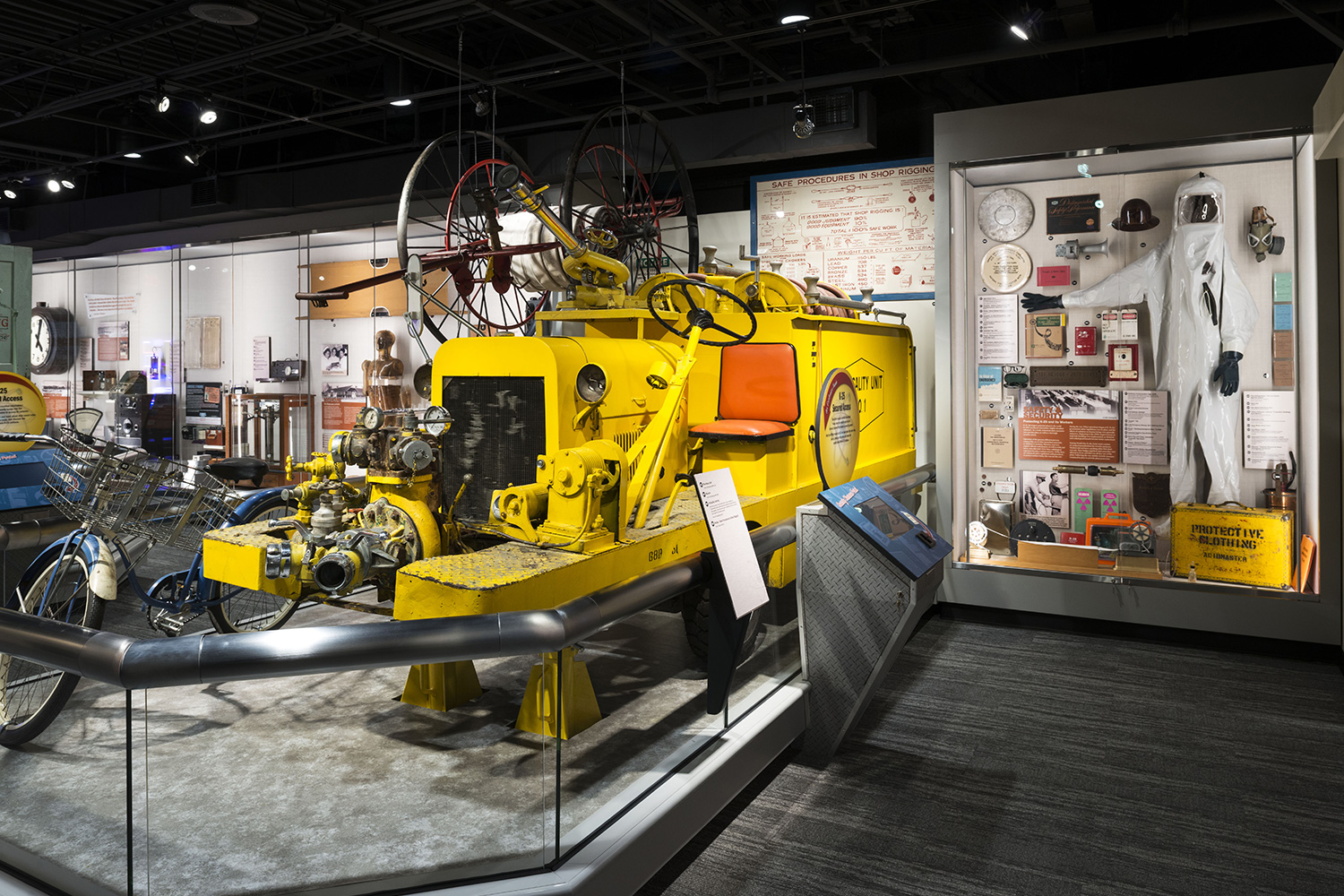
I lived in Los Alamos for a while. I looked into renting a studio space. I became curious about the property across the street from my prospective rental which was surrounded by a chain link fence with green canvas. I researched and learned it was the site of an original Manhattan site waste dump which had, a few years prior, been enclosed with a negative pressure tent and cleaned up at a cost of 2-3 billion. Apparently the government had dumped an unknown quantity of high level nuclear waste there in an unlined pit in the dirt in the 40s. This led me to research the history of the area.
After a couple of months I figured out that my house in White Rock was about 3/4 of a mile from the current waste dump for the entire lab, known as TA-53 or MDA-C or something. They were in the process of excavating the three 200 foot deep pits of MDA-C - one for low level nuclear waste, one for transuranic (as they call “high level” these days) and one for classified waste. If I stood on my roof I could see the negative pressure tents surrounding them. My favorite non-classified project which was disposed of there was the “experimental high temperature plutonium reactor”, from the 90s.
The lab has some rather interesting history. There was no concept at all of safely disposing of anything or even recording what they dumped and where until the 60s. The first ever radioactive metal working facility, out on a ridge by the entrance to town (TA 21? 23?) dumped all of their wastewater directly into the canyon untreated. This has recently been cleaned up at a cost of several billion dollars also, and now they are building homes there. The heavy/radioactive metal plumes went down into the earth over 500 feet. In fact, all of the waste from the entire lab used to be dumped into a stream in the middle of town. They cleaned it up, opened it as a park (“Acid Canyon”), then after heavy rains found some barrels they missed which were determined to contain plutonium waste. Oops, cleaned that up some more and now it’s a nature preserve and hiking area. There are still untouched facilities from the 50s where Feynman worked on polonium experiments sitting a few hundred feet from the banks of the Rio Grande.
There was a power plant right on the edge of a native reservation neighboring the lab. According to the federal government, the plume of chromium contamination it left ends exactly on the property line of the lab to the reservation.
Everyone I met in Los Alamos had zero concerns about pollution having an impact on them.