The inconvenient truth about NYC G&T program is that it is 40% Asian. Asians have dominated the G&T program, even "stealing" spots from white kids where 43% of NYC is white, but only 35% of spots taken by white kids.
And Asians are dominating the NYC G&T program NOT because of hundreds of years of systemic racism, NOT because Asians wrote the admissions tests an inbueing cultural bias, and NOT by cheating or bribing admissions. And in NYC, Asians are the poorest demographic by a large margin. This makes the entire story extremely inconvenient for activists who want to say that the program is racist and discriminates against the economically disadvantaged. And yet, they somehow are able to get the entire program trashed because of racism against Asians is perfectly accepted in 2021.
Activists have no problems openly discriminating against Asians because whites, blacks and Latinos think of "Americans" as whites, blacks and Latinos. Asians are considered foreigners. So when a prestigious program is dominated by Asians, something must obviously wrong, right?
Activists have gutted admissions at Thomas Jefferson high school in Fairfax, VA, arguably the top public high school in the US because it had a high percentage of Asians. Lowell High school admissions in SF, a top 100 high school, underwent the exact same thing because of its high percentage of Asians. Now NYC is doing the same thing. At Harvard, the admissions department openly discriminates against Asians by saying they lack "courage" or less "likeable". Imagine the outrage if this happened to Blacks, but because it happened to Asians it's considered okay because Asians are unAmerican.
> Activists have gutted admissions at Thomas Jefferson high school in Fairfax, VA, arguably the top public high school in the US because it had a high percentage of Asians. Lowell High school admissions in SF, a top 100 high school, underwent the exact same thing because of its high percentage of Asians. Now NYC is doing the same thing. At Harvard, the admissions department openly discriminates against Asians by saying they lack "courage" or less "likeable". Imagine the outrage if this happened to Blacks, but because it happened to Asians it's considered okay because Asians are unAmerican.
Also notable is that California is finalizing a proposal to eliminate faster tracking in mathematics, arguing that it is a promotion of white nationalist ideology. Calculus may only be taken in the senior year under these proposals, and Algebra is to be de-emphasized as the primary math target of middle school.¹
I found it quite striking that in a long proposal focused on racial justice in math, there is plenty of mention of white nationalism but exactly zero mention of the word "Asian".
I would have been diagnosed with ADD and medicated if I hadn't been put on a faster track. Luckily the teacher correctly observed to my parents that I was just bored. I don't know what would have happened to me in a system without that track. I probably would have been a much less happy child.
It went the other way for me. Got the ADD diagnosis and put me into classes with kids with downs syndrome and other profound disabilities. Let me tell you, that isn't great for your social life. I ended up leaving as soon as I was legally allowed and got a job.
This supposed ADD disappeared once I got into the real world and was given actual problems to solve. I think they did it mostly to keep their test scores up. I have no faith in the education system as a result.
> 43% of NYC is white, but only 35% of spots taken by white kids.
The NYT deftly avoids mentioning this by stating it as
> Though about 70 percent of the roughly 1 million public school students in New York are Black and Latino, about 75 percent of the roughly 16,000 students in gifted elementary school classes are white or Asian American.
> Activists have no problems openly discriminating against Asians because whites, blacks and Latinos think of "Americans" as whites, blacks and Latinos. Asians are considered foreigners.
I don't think this is true. Asians are being punished because they're successful, and their existence bucks the narrative the blank-slate activists want to push.
Sure, as a group they're being punished, but it's not because anyone sees them as exceptionally foreign. It's just because the top has to be brought down in order to achieve equality of outcomes and the fanatics pushing these things don't care who they harm to achieve their goals.
>I don't think this is true. Asians are being punished because they're successful, and their existence bucks the narrative the blank-slate activists want to push.
No. Everyone is being punished, not just Asians.
Ditching G/T programs is going about this completely backwards, and hurts all students regardless of ethnicity or melanin content.
The problem is that schools in poor and minority neighborhoods suck.
Let's fix that problem and the rest will take care of itself.
Part of the problem is, as you mention, the schools. But the other, much harder part of the problem, is the homes. If your parents aren’t engaged in parenting and you come from poverty, you are at a disadvantage that in no way can be fixed by the time you spend at your school each day. You’re treading water at best.
If you want poor kids to do better, you have to improve their home life.
I think even more important than home is peer groups. Research I read about in The Nurture Assumption [0] convinced me that much more important than home life (home life being called "shared environment" I believe because in a twin study it's the thing most shared by two non-biologically related siblings) is peer environment. If your friends all think that learning isn't cool and tend to do drugs or whatever, children will follow in that path, and parenting affects that very little despite our intuitions.
How to solve the peer group problem? As far as I know it's extremely difficult, even more than reforming home life. You can split up peer groups and distribute their members into peer groups with different mindsets and they will generally conform, but the ratio has to be quite steep towards the peer group you're integrating into. I don't know what the number but I would guess something like 15 to 1. There's definitely not enough middle and upper class classrooms to go around to house all kids from more troubled areas under my stated assumptions. But perhaps the process could be incremental?
>Part of the problem is, as you mention, the schools. But the other, much harder part of the problem, is the homes. If your parents aren’t engaged in parenting and you come from poverty, you are at a disadvantage that in no way can be fixed by the time you spend at your school each day. You’re treading water at best.
A fair point. Although I came to the conclusion when I was in school that while the impact of your home life is important, providing a positive initial experience with school and having high expectations for scholastic performance can do a lot to improve educational outcomes. Perhaps even enough impact to counteract the lack of parental involvement/motivation for education for some.
No, everyone is being helped, not just Blacks and Hispanics. Even most White and Asian students who would benefit from accelerated study in one or more areas are excluded by NYC’s current program.
> Ditching G/T programs is going about this completely backwards
No, its not.
Ditching accelerated student-specific programs would be, but this plan vastly expands such programs, putting them in every kindergarten classroom, available to every student, rather than less than 10% of schools, available based on all-or-nothing test to four year olds.
> and hurts all students regardless of ethnicity or melanin content
How does making student-specific accelerated content with teachers trained in delivering it in every kindergarten classroom, and added experienced teachers in disadvantaged communities, rather than accelerated material made available to a small minority hurt everyone?
> The problem is that schools in poor and minority neighborhoods suck.
You know nothing about teaching and education if you think this is going to help. It's going to hurt even more. The reason why you group children with similar learning abilities together is so that they can progress together. If you stick advanced kids with less advanced kids, both sets of kids will suffer because the advanced kids will be extremely bored and the less advanced kids will get discouraged because the advanced kids are so much better than them. It goes against the fundamentals of education.
> The reason why you group children with similar learning abilities together is so that they can progress together.
Yes, that's the thinking that justified tracking. Among the problems with segregated G&T programs, however, is that G&T-identified and non-G&T students are not, within each group, “of similar learning abilities”; Both have wide variation within groups, and individuals very often aren’t in the same relative position within their group in different specific subject areas.
As much as tracking would make (simple, binary) varying ability fit into the industrial assembly-line model of education, it doesn't work well with real people in the real world (it works very slightly better than the industrial assembly-line model without tracking, and when that was the norm, it was an improvement.)
But what works significantly better (though it takes more work) is to provide baseline curriculum with supplementation to individuals (in small groups of similar ability in the subject, where possible) based on ability. Which is what this proposes training all (initially) kindergarten teachers in, and hiring additional teachers in particular areas of need, in place of a high-stakes tracking exam for four-year olds. Its what has proven better than binary tracking in many places. (And it is, incidentally, what decided my family’s choice of schools for my son, who is now in kindergarten.)
It’s not the 1980s any more. Education has moved forward. Whether NYC will execute this well is, of course, up in the air. But that what it has identified is what has been widely used and proven better than binary tracking already, for the students that would be tracked into G&T, for the students that would not, for racial and socioeconomic class equity, and in basically every other conceivable manner is not up in the air.
You are exactly the type of person who is pushing out the best kids into private school. Private schools in California are getting record numbers of enrollment after how horribly public schools handled the pandemic, and after how it wants to gut programs in the name of "equity". Your kind will reap what they sow, because it will create a 2 class system where anyone who can afford private school will go there, leaving essentially the economically most disadvantaged in public school. And along with the students, people will fight to cut money to public schools as well, since many will be paying for private schools.
Kids that are advanced need to be with other advanced kids. Not all kids are equal in ability. Using weasel words to push an agenda of "equity" that hurts the best and brightest is what will kill public education and push moderate Democrats such as myself to voting for Republicans who want vouchers to gut the public education system.
>It’s not the 1980s any more. Education has moved forward. Whether NYC will execute this well is, of course, up in the air. But that what it has identified is what has been widely used and proven better than binary tracking already, for the students that would be tracked into G&T, for the students that would not, for racial and socioeconomic class equity, and in basically every other conceivable manner is not up in the air.
You make a bunch of really good points. I haven't been in the NYC public schools in nearly 40 years and the elementary schools in nearly 50, so I was unaware that the G&T programs weren't actually housed and run within each school.
In fact, when I was in elementary school (1971-1978), the gifted and talented programs were just getting started, and were housed within neighborhood schools[0] as a separate track.
After reading your (and a bunch of other) comments, I realized (as you already knew) that G&T programs had been moved to completely separate schools. Which is a terrible implementation of G&T.
But even back then, only a small number of city schools had those programs at all (they certainly didn't at mine -- PS 84 and JHS 117).
I was just a kid, so I don't know what justifications were made for moving all G&T programs out of the neighborhood schools.
There should be G&T (or some tracked analog) in every city school, something to which you alluded.
tl;dr: You were absolutely correct. My comments were based on an understanding that was decades out of date.
There is a whole narrative that people are equal and have same capabilities.
Anyone can be a sport start if trains enough or a super scientist if study enough.
Then looking at statistics it is not true.
The same people with cognitive dissonance claim that because social factors, etc. Usually whites get a better treatment thus because and only because of that they have better representation in certain areas (only certain).
Then a lot of money is poured in programs to fix that. Because the narrative says all people are equal.
The opposing narrative says that IQ is genetic and it reflects on career that needs IQ so it really does not matter it will always reflect that.
The two narratives are fighting: social-economics vs genetics and if its a fair fight.
Came the asians.
Poor, non-english skills, living in bad neighborhoods.
They start getting advanced classes more than white. They advance more.
Then looking at statistics we can see Asians have higher IQ and looking on Advanced programs we have Asian as the largest, Whites as second and others as third.
Bang one narrative suffers a blow. Then they start changing rules. "Asians are White".
"We need to make it more equal" meaning removing asians from programs.
While these boths narrative fight we as whole suffer.
As I want the best players on Soccer I want the best players on Medical field or Math.
I really don't care if the whole Math department is Asian. I care about the results to the society.
It's not I.Q., it's culture. Asians have a significant cultural focus on education. But then again so do a number of Black African minorities like the Igbo, Ashanti and Yoruba. So even "race" is a complete red herring.
Culture, 100% is the reason. But I feel the real problem here is how we CANNOT talk about the negative effects of culture. Growing up black/Mexican I was made fun of by blacks and Mexicans for being smart, acting white etc. and I know I'm not the only one who experienced this.
Intelligence was not valued in black culture when I was growing up and I'd argue is still not.
I've heard this before about black culture (hadn't about Mexican culture though) and it's quite sad.
I could be way off the mark here, but to me it seems like the reason for this is that if one has been blaming external factors for all of their failings, it doesn't feel good to see someone with the exact same limitations pushing ahead. It hurts the excuse that one has been making to oneself about what the reasons for not being successful are.
But as embarrassing as it might feel to have others surpass oneself, dragging others down is never a good way to handle it. Fixing that really requires a culture shift and I'm not sure that any amount of changes from the outside can have a notable impact (if anything, pushing too hard for change from the outside can make people stick harder to their ways of thinking).
Asians are not genetically more intelligent than other races. If this were the case, Asia would be more of a powerhouse than just the "factory workers of the world". Only a small amount of innovation is coming out of Asia compared to the US.
Asians in the US are more motivated to study, it's the culture. It doesn't take a lot of dedication to studying to get a major advantage over those that don't study as hard.
China and Taiwan are in Asia. Between the two of them there is at least as much if not more tech know-how (soft & hard) in many areas (e.g. face recognition, semiconductors) compared to all others continents combined.
>Only a small amount of innovation is coming out of Asia compared to the US
This is a meaningless claim, and also the fact that you are hardly exposed to the innovation that Asia brings to the table, only US. (Note what website you are writing this on)
100 years ago China was barely a country, ripped apart by opium, politics and various countries that occupied China. It took Dr. Sun Yat Sen and subsequently Chiang Kai Shek and then Mao to get China back on its feet and now is a global power because of its 2 billion people.
But you can't compare the innovation of China to the US... for the time being. Admittedly the inflection point is coming soon if the US doesn't get it's head out of its ass.
to play devils advocate, humans have been the most intelligent species for a long time, but haven't always been the dominant one.
further, we shouldn't assume the "most intelligent" rise to the top in terms of hegemony and leadership ex. Trump and our world governments in general.
Another inconvenient truth is that there is a great example of an integrated G&T school student body in East Harlem whose racial profile [1] closely matches the racial distribution of applicants for the G&T kindergarden test[2].
Two problems arise when trying to raise the profile of the school:
1) This is one of the only good examples of integration, but nobody seems to be interested in learning how to replicate this model high performance and integration across the rest of NYC's schools.
2) Draws unwelcome attention to the pipeline problem whereby some ethnic groups are underrepresented compared to the city's ethnic makeup when applying for the test.
One of the first openly racist interactions I ever witnessed in the US was a white guy hurling slurs at a Vietnamese friend of mine. Asians are definitely in a strange predicament here.
> in NYC, Asians are the poorest demographic by a large margin.
Do you have evidence for this? Asians are by far the richest minority in the US so I was surprised by this statement.
> Activists have no problems openly discriminating against Asians because whites, blacks and Latinos think of "Americans" as whites, blacks and Latinos. Asians are considered foreigners. So when a prestigious program is dominated by Asians, something must obviously wrong, right?
Diversity means increasing representation. In a situation with limited resources, increasing representation for all means decreasing representation for some. This is the natural conclusion to pushing for equality/representation.
>Diversity means increasing representation. In a situation with limited resources, increasing representation for all means decreasing representation for some. This is the natural conclusion to pushing for equality/representation.
Except the problem isn't with the gifted/talented programs in NYC. And it isn't with the SHSAT[0] either.
The problem is that public elementary and middle schools in majority black/hispanic neighborhoods have measurably much worse educational results.
What's more, those schools don't even consider preparing their students for G/T programs or the specialized high schools.
There are many reasons for this and fixing it is hard. As such, instead of giving minority students a better education, some activists are calling for (and succeeding) removal of gifted/talented programs and getting rid of the SHSAT.
As a product of the NYC public school system, I have no illusions that fixing these problems will be easy.
But removing the G/T programs instead of directing poorly performing schools to bring all their students up to educational levels which allow the best of them (as in every other school) to participate in G/T programs and increase their numbers in the specialized high schools.
IMHO, this is completely ass backwards.
And De Blasio is gone in January, leaving this mess to his successor.
As a NYC resident, I'm glad I don't have kids here.[1]
[1] I could go on and on about how ridiculous this is, but I am so disgusted with De Blasio and the NYC Department of Education about this stuff that I'll just stop now before this becomes an all out rant.
> The problem is that public elementary and middle schools in majority black/hispanic neighborhoods have measurably much worse educational results.
Are the students doing poorly in those schools because they are poorly run/staffed/and funded, or is it the case that the students in those schools have more problems at home leading to poorer results?
In other words, is this a problem schools can fix at all?
>Are the students doing poorly in those schools because they are poorly run/staffed/and funded, or is it the case that the students in those schools have more problems at home leading to poorer results?
There has been research (don't have it handy right now) that there's a negative feedback loop with that.
Schools in poor areas tend to have less parental involvement (and direct economic support from those parents as is common in wealthier neighborhoods), so school staff don't have as many resources and aren't as incentivized to raise expectations of the students.
That creates an environment where the students aren't learning as well as in other neighborhood schools.
I suspect that if the authority figures on either side of that raise their expectations and requirements of the students, the negative feedback loop can be, at least partially, short-circuited.
>In other words, is this a problem schools can fix at all?
Yes. They can't do as much as schools with significantly more parental involvement, but improving the teacher/staff performance would likely improve parent performance.
No, it's not a panacea, but blaming all this on poor parenting and throwing up our hands just promotes the centuries-old trope that "poor people are morally and intellectually inferior. It's obvious, if they weren't so they wouldn't be poor."
That's circular reasoning and doesn't reflect reality.
> Diversity means increasing representation. In a situation with limited resources, increasing representation for all means decreasing representation for some. This is the natural conclusion to pushing for equality/representation.
This is the natural result of equality of outcomes, which is achieved by dragging down the top to meet those who can't excel. That is not at all what most people mean by equality, and is frankly a perversion of the word.
> In a situation with limited resources, increasing representation for all means decreasing representation for some. This is the natural conclusion to pushing for equality/representation.
This links to https://www1.nyc.gov/assets/opportunity/pdf/20_poverty_measu... as the original source. On page 28 of this file, you get to the actual statistics. While Asian poverty is certainly high, it is about the same as other minorities, and has been decreasing since 2014.
No, the report says that Asians poverty is underreported in the data.
EDIT: I think that the report shows that Hispanics in 2020 have a higher percentage of poverty than Asians, but it seems like a lot of the articles showing Asians had the highest poverty rates came from before 2017.
It looks like in the last 5 years prior to 2020, Asians had improved the poverty rates.
Regardless even in 2020, Asian poverty in NYC was 22%, Black poverty was 19%, Hispanic poverty was 24% and White poverty was 13%.
I don't know enough about the situation to speak any further on it, I was just as curious about your statement " in NYC, Asians are the poorest demographic by a large margin." as silicon2401 was.
It's a dire situation for sure, but I think using "large margin" is disingenuous.
It depends on what Asians we are talking about. I bet if you correlate income to gifted access, you’d get a lot of Indians and Chinese in those programs, and many fewer Vietnamese, Filipinos, and Indonesians (doubly so if we break out Chinese ethnicities from those countries).
In Seattle, Asians dominate both the high end and the low end (south Seattle has a lot of poorer southeast Asian immigrants, north Seattle has more East and richer south Asian immigrants). It all depends on NYC’s racial mix over the broad term Asian.
I don't know what you're reading, but Thomas Jefferson High School is not in Fairfax. It's here in Alexandria. Fairfax would be half an hour drive for me and I live on the extreme, western edge of Alexandria. There's a whole, other city in between (Annandale). It'd be like saying something was in Brooklyn when it's actually in Queens.
Virginia is a weird state. Fairfax and Alexandria are classified as "independent cities", which exist in parallel to and outside of counties. There are only 41 independent cities in the US: Baltimore, MD; St. Louis, MO; Carson City, NV, and then 38 more in Virginia.
The signficance is that independent cities can't levy income tax, but have to pay for their own schools and roads. We make revenue through property taxes (not just land/houses, but also cars! That's a whole other story) and business licenses. The state then calculates how much it will contribute to our school funding based on our supposed "ability to pay".
Between property values and transit issues here, there are a likely more "property owners" in Fairfax than here in Alexandria. Alexandria is much more of a bedroom community for DC, whereas people in Fairfax spread more across NoVA for work. The state sees the higher property values in Alexandria, and our higher population, and thinks "oh, they are loaded, they don't need so much". But we're not. We're a town of renters. All the property is owned by DC and NYC property developers, which got sweetheart tax break incentives to build here.
You can readily see it when visiting. Fairfax's roads are nicer. Their public buildings are newer and larger. They have several, gorgeous, gigantic public parks with stuff like kiddie train rides around the perimeter. Fairfax is apparently rolling in cash. And Alexandria can't even fix a foot bridge across a 20-foot wide creek bed.
So we just don't have the money to fund our schools anymore. Hell, my own kid's school is one of the better ones in town and they can't even afford to have enough bus drivers and substitute teachers for the year. It's garden variety bad administration over the last 15 years, not anti-Asian sentiment.
Well, chalk one up for "Virginia politics are stupid and unnecessarily complicated". I just learned that our school "divisions" (not districts like the rest of the country) have no correlation to our municipal structure, but also are incapable of doing their own revenue collection. We still can't afford basic stuff for our schools, despite NoVA being regularly ranked one of the richest areas in the country. Urban schools get about 1% more per student than rural schools from the state. They claim to incorporate cost of living adjustments, but it's clearly not enough if we can't do basic things like hire enough bus drivers.
This bullshit is a vestige of the Civil War when West Virginia split of to be an abolitionist state. I don't understand the fetishization of such "culturally important" (sarcasm) things like municipal structure when what we have is not working. "This hammer was my great, great grandpappies, that he bought from the Sears Robucks Catalog in 1887. Yes, the handle is cracked and the claw can't grip modern nail heads, but by God, it was good enough for him, it'll be good enough for us".
My apologies. I've since learned that TJ is a Fairfax County School Division school. TJ is smack dab in the middle of Alexandria. I didn't realize how unrelated Virginia's school division system is to its municipal structure. I didn't grow up here, so it seems absurd to have a completely different county's schools in our city.
I don't really get that undercurrent to the decision making processes here.
Yes, NYC's specialized public schools have become heavily disproportionately filled by its Asian and Asian-American population.
The competitive forces and consolidation does a disservice to them and the rest of the admitted population as well.
When a 4.2 GPA overachieving student can't get selected to good universities or other opportunities because of all the 4.5 GPA students at the same school, that undermines the point of the system. And that system also has the side effect of exacerbating segregation?
And you want to defend it by making it about other Americans focusing specifically on disrupting Asian achievement? I understand your sentiment is and has been shared and represents a collective assumption with some groups in NYC, but its a huge stretch! The other perspective is that it just doesn't accomplish externalities well. Mix the schools up, let cultural overachievers be dispersed instead of consolidated, the mindshare will help the overall local population better.
I agree that public schools should be about education, so focus on fixing where the education occurs. Try to get better teachers and materials to other parts of the city! Yes, if your child is trying to go through school before any of this better infrastructure is set up, I can see how defensive one would be about it, I can see why the low hanging fruit of "they dont want us/my race to win" is the goto argument, but all I can say is.. welcome to the rest of the country? Shitty public schools is the most American thing ever!
> Yes, NYC's specialized public schools have become heavily disproportionately filled by its Asian and Asian-American population.
Have they? The admission criteria is based on scores. The school is disproportionately filled with over-achievers who happen to be Asian.
> When a 4.2 GPA overachieving student can't get selected to good universities or other opportunities because of all the 4.5 GPA students at the same school
How is that so?
> Mix the schools up, let cultural overachievers be dispersed instead of consolidated
How is that supposed to help anyone?
> all I can say is.. welcome to the rest of the country? Shitty public schools is the most American thing ever!
Because someone eats junk food I should have to eat it too?
That's not how cultural overachievers work though. Group overachievers together and they form a stronger culture of achievement. Split them up and they stop achieving.
My brother teaches at an exam school in Boston which similarly had its requirements dropped recently, and it seems like a lot of these changes are poorly thought out and done for optics. Sure, some of the exam schools in BPS are overwhelmingly White/Asian, but the school he teaches at is mostly Black/Asian/Hispanic.
While he was previously able to teach classes of bright, focused students, now they need to break up fights of unruly students and divert their attention to the ones that are struggling. I imagine the parents that can afford it will likely remove their kids from the public school system if quality continues to drop, which will only hurt funding.
The real issue is a much more complex socioeconomic problem, but that's hard to solve, so it's easier to point the finger at schools.
In 2018, the vice principal of anti gang violence was convicted of recruiting students there to deal drugs for him, then attempting to execute one of them with a gunshot to the head for withholding drug profits https://www.wbur.org/news/2018/05/31/shaun-harrison-guilty-b...
There is no talk on the left of how to fix these schools, other than giving them more money, which they are already the highest funded in the country. The progressives need to rethink their school reform plan otherwise society will continue to exit the public schools and go private or home school.
What the NYT article omits is that the elimination of advanced classes has been preceded by a couple of decades of highly restricted availability. 15 years ago (shit I’ve gotten old), when I lived in nyc_borough, there was precisely one elementary school honors class for the entire borough. 30 spots for the entire borough. I didn’t bother to wait and see if my kid managed to get a spot, we pulled her out and stuck her in private school.
This is the issue at the school I taught at. Our guidance officers and previous admin have actively been working to gut accelerated and honors classes. All this does is harm those kids (I was one myself at the same school; I took more AP classes my junior year than they even offer now), as well as the lower level kids who you have to try to balance out the others for.
Hell, I've had collab classes where half the students have an IEP and the other half are in whatever honors classes are left (not science sadly!) because our guidance doesn't care. They also actively tell kids not to challenge themselves and do whatever's easiest. Actively ruining the school because they don't give a shit about education. Hopefully the new admin changes that
I am generally quite liberal but I strongly disagree with he current strain of progressive education reform. There are inherent differences within the capabilities of students, we can detect these early, and we should use them to provide students with appropriate challenges. Our education system should provide avenues for top students to excel, ad hopefully these top students become the people who create businesses or invention that improve the world.
This seems to be a "present" of an older generation that fundamentally didn't put in any effort to understand their successors. With exception to the newest generation that now believes that racism is everywhere.
That said, I think logistics of education today can supply almost everyone with a high quality education anyway and the role to connect people moves from universities to other places. So less elite and more broad high quality education wouldn't hold anyone back and is a better approach.
Or this is the inevitable end of leftist thinking every single time. Sounds good on paper, fairness and all that, but totally ignores reality and ends up requiring large amounts of violence to enforce its idea of equal outcomes for all, where that equal outcome is always poverty and starvation.
I dislike the racial focus just as much, it will result in authoritorian bullshit every time. But that isn't really a "leftist" stick, at least I hope so for their own sake.
Freedom and equality contradict themselves at some point, but I do think everyone has a right of participation in society and education. Forcing "representative" distributions is a flawed approach for multiple reasons. And we know it cannot even be true at this point, there is far too much contradictory evidence. I don't understand why people still believe it to be desirable. Women in IT is a staunch example.
Elite education lately just sold the correct contacts although the quality of education was indeed high. With todays communication infrastructure it would be a net loss to restrict the audience here.
The twitter mob doesn't like to hear that but it's absolutely true. It's illiberal, intolerant and regressive. Actual progressives and liberals see this clear as day. Most of us are just too afraid of the mob to say it.
>you don't have to be super-smart to succeed in K-12.
Yeah, you don't have to be super smart to succeed in a warehouse-mentality K-12 system. In fact, it helps not to be. Wait, I think you just proved the benefit of advanced classes in K-12.
This comment doesn't make any sense. A gifted and talented program is not the same as the existence of "advanced classes" and isn't what article is referring to.
Yes, kids are different. That does not mean that existing systems do a good or fair job of determining which kids would benefit from special programs.
My experience being in a "gifted" program in middle and high school in Florida was that the students in the program had parents who knew enough to get them tested. That alone marks a privileged class. I sincerely believe that if every student had been tested, the makeup of the gifted, honors, and standard classes would have been much different.
(I graduated high school in 1990. Maybe things are much different now. I would have no way to know.)
What tests would they be? My point is that, at least in the system I experienced, a fraction of students were given IQ tests. They were then placed into special classes. Is jxidjhdhdhdhfhf wrong?
That’s my point. When I was tested as “gifted”, it was an IQ test. Not every student was tested. Testing every student would have resulted in different outcomes. That is not fair.
The problem with the G&T program was that it did a better job of selecting for parental affluence (the ability to pay 4-5 figures for test prep for your toddler, and the time to navigate a byzantine system) than for inherent differences in student capabilities.
Strangely enough, there were also a very limited number of G&T programs, including none in many of the poorer areas of the city, so if you lived in, say, the west side of the Bronx (as a friend of mine did) and wanted to send your kids to a G&T school, your best case was a 1.5 hour transit commute to East Harlem. My friend and his spouse could do that because they had work flexibility (including the flexibility for one of them not to work), but poor people don't usually have that either.
Effectively, this works out to socio-economic desegregation masquerading as racial desegregation (because, for various historical and structural reasons, race in NYC is correlated to affluence).
There are numerous sources in this thread that show that the Asian group, highly selected for here, are predominantly poor. Just parroting a talking point without looking at the data is as idiotic as what we all accuse Trump supporters of.
To counter evidence with evidence, the "Asian" group is very heterogeneous, and more bimodal with respect to wealth than other groups[0][1]. Has anyone presented any data that I missed on which side of that divide the Asian G&T students in NYC schools are being drawn from?
I'm not sure that's counter evidence (i.e. it doesn't lend proof to the OP's position either, it just decreases the certainty of both positions).
The only source I could find with respect to your question is that "Students from the 19 poorest districts, who make up about 31% of kindergarteners citywide, represented about 28% of gifted offers last year" (https://www.nydailynews.com/new-york/education/ny-gifted-adm...), but I do not have the primary data.
Given the overall ethnic representation of the school, it is statistically extremely likely that a large fraction of the 28% are Asian.
I also find no cited evidence in many of the pro-ending-G&T articles that G&T programs cater to wealthy students, and presumably De Blasio and others who have access to the data and want to end the programs would have pushed those facts out there.
Anecdotally, wealthy whites and asians have the opportunity to send their children to private schools without spending a large portion of their young lives testing into G&T programs.
> The problem with the G&T program was that it did a better job of selecting for parental affluence (the ability to pay 4-5 figures for test prep for your toddler, and the time to navigate a byzantine system) than for inherent differences in student capabilities.
Spoken so authoritatively that I'm sure you have a source?
Public school should provide a basic education to all students, not a better education to some students. Resources that were used for a 'gifted and talented' track should be allocated to help the more needy.
Especially in later years, segregating the 'smarter' students is a net loss for the under achievers. How could those 'smarter' students be helping tutor the under achievers?
Public school was about helping those in poverty get an education. The middle and upper class has infiltrated the school system for their own purposes. Personally, I'm against public schools in any form, but if they are to exist, we should be trying to ensure all kids have access to the same basic education, not rewarding the ones that already have a higher chance of success.
Why can't we acknowledge the simple fact: some kids are smarter, they learn faster, they remember better?
I went to gifted and talented programs, and even there I felt like the pace was slow and easy for the top kids. If you put those kids into classes with even less academically apt, less focused children, those top kids are going to be bored out of their mind and wasting their time.
Do we truly want to waste the time of our most bright young minds? Do we want to squander their potential when they pick up 1+1=2 in 10 seconds, but it takes other kids 10 minutes? Do we have to force our teachers to make 4-5 different lesson plans, 1 for the lowest, 1 for the highest, and a couple others for the mid-tiers? We're already asking too much of teachers, give them smaller classes with less of a range of aptitude.
Wasting their time wouldn't even be much of a problem. Many become really destructive and it can result in them dropping out. A bored kid will not have iron discipline, maybe especially not the smart ones.
> How else are we gonna detect the asshats if they don't tribalise themselves at Poly Prep?
Maybe we can just judge them by what they put out in to the world?
Such as naming their personal blog something really pretentious?
Or you know, like, having utterly pretentious quotes in their HN bio?
> churchofthought.org
> Hardy couldn't have been more wrong about the innocence of pure mathematics. But we live by his legacy. In the sands of time, where do you dine? It better be divine!
But sure, you could judge them on choices their parents made to maximise their childrens' potential instead?
Not US but judging by the continuous amount of violence happening in certain American public schools, I would 100% be sending the kids private or moving to suburb where the threat of violence is distant.
The answer is probably "more gifted programs in low-income neighborhoods". This is of course racist against Asians (they are lumped in with white when it's convenient). They make up 43% of these schools, so whites, and POCs are underrepresented. Why are Asians doing better? Are they more intelligent, work harder, value education? Let's pretend there is no problem by just eliminating the schools. Of course, there are problems with gifted programs, but assuming that factory education will maximize all the students potential is obviously wrong. This is a pollical maneuver designed t placate a segment of voters. We need every smart mind being educated properly regardless of the circumstances of birth.
Public schools in NYC rush to the lowest common denominator to address cries of racial inequity. This only takes away futures for children who would have had any future because they weren't among the general population of future convicts or minimum wage earners. No one is better for policies focused on racial parity when the bar is vastly lower because of it.
It's long been a fallacy that you can sort young kids into high or low performers. Its a self-fulfilling prophecy kind of thing. By starting so young (kindergarten!) in NYC they were creating the division out of essentially nothing.
Long ago somebody tried dividing an elementary school class into regular and advanced students. At the end of the year, the advanced students had done better. The selection was a random lottery. The difference in performance, was entirely based on expectation.
>It's long been a fallacy that you can sort young kids into high or low performers.
As someone with teaching experience, I find this incredibly hard to believe if you were sorting by raw talent on not something that can be gamed like basing it on grades/good behavior. Certain students have a better natural aptitude for certain subjects.
I also think at kindergarten age, you are actually just separating by age. A kid with an early birthday could have lived 11 months longer than a kid with a late birthday, and when you are only 4 or 5, that's a good chunk of your life. See Malcolm Gladwell.
Thinking that someone will perform better can help them perform better, sure. But that doesn't invalidate the whole thing.
> By starting so young (kindergarten!) in NYC they were creating the division out of essentially nothing.
I think that by kindergarten you already have lots of factors that will statistically influence school performance. I would argue that some will be environmental, and some will be inherent to the kid.
> Long ago somebody tried dividing an elementary school class into regular and advanced students. At the end of the year, the advanced students had done better. The selection was a random lottery. The difference in performance, was entirely based on expectation.
I mean, that's obviously going to be true. But how big was the difference? Was it bigger than when students are chosen with another method? Which method? Which one performs the best? What you're describing is basically the placebo effect, but applied to this situation. It's a good control group, and we already know that placebo works. The interesting part is to see if the current programs work better or worse than placebo, and by how much.
Education research is more heavily plagued by poor methodology than even psychology - the only reason it lacks a replication crisis is because it doesn’t have the academic integrity to bother trying to replicate anything.
It is the epitome of shitty studies cherry picked to support the idealology/politics of the day.
Thank you! I did a Masters of Arts in Teaching because it was required for me to teach without an education degree (physics) and man were those studies such bullshit, and the generalizations they drew were so bad. Glad I'm not the only one who sees it.
Perhaps more than just 'expectation' i.e. those who feel they are special and talented may actually strive harder. Maybe a bit of pressure as well.
But there's a lot of truth to this I think people should cognize.
That said, I'm wary of NYs move, in the later years of high school, providing programs where kids can be among other kids that really want to learn is powerful.
At my school, they didn't actually 'vet' students in the advanced program. You just did it if you want. I think that's fair.
You can have Algebra 101 and Algebra 101++, which covers more ground, at an accelerated pace, and it's your choice to join. I think that would work.
Could you share a link to that random allocation of students into regular and advanced? Sounds fascinating, though not surprising: imagine the confidence hit of being told by the system you're not advanced.
It's possible that the average school provides insufficient challenge & motivation for the average student, so that rising expectations results in a rise of performance. It's also likely that an "advanced" programme was less tolerant to disruptions and required students to focus more.
But regardless, that doesn't change the fact that there are difference between people, and they're shown very early in development. It's things like, a kid not understanding whether a train is alive (it moves!) or not. Later, it's things like a person being able to understand basic math or not (I was the smartest kid in class, and had to tutor one of the worst... it was painful - he simply couldn't understand math! I tried all different ways of explaining, ended up having to teach him a mechanistic formula "write parenthesis this way, then keep trying numbers until the sums match").
No program was provided. The kids were just labelled. The label was a placebo, and it worked.
Straw-man examples of differences in kids are cute but not helpful. The issue was the imbalance in NYC advanced programs was clearly racial, which begs some kind of correction. Or do we have to resort to "Black kids aren't ever smart enough?" Is that your argument?
Why would structural racism in NYC's gifted and talented program exclude blacks while including Asians as the largest plurality, despite that they are among the poorest demographics in NYC? What is the explanation for this kind of effect size?
I'm black and I was in a gifted program in elementary school on through honors college at university. I was surprised when I first heard someone say gifted is racist about a year ago.
At the same time, though, I feel like I was raised in a time where not as many parents are actively trying to game the education system. It seems to ruin the spirit of the gifted program if parents are looking up tricks and tactics to get their kids to ace exams in Kindergarten.
I am all for supportive programs for really smart kids. FWIW my kids go to NYC public schools. We did not go with gifted and talented because we didn't really like the structure of the program. If the city ends up providing REAL enrichment for gifted kids past 3rd grade it will be a net gain for everyone.
It is pretty ridiculous how pervasive test prep is for pre-school age kids to get them into the G&T program.
I know lots of parents who “chose not to go with it” when their kids aren’t selected for gifted and talented.
There are many flaws in gifted programs and they aren’t perfect. But they do have advantages like more child autonomy, more allowances for child-directed study, and more encouragement of curiosity.
Not all children have academic curiosity and so gifted isn’t a good fit for everyone.
But for parents who want their kids to achieve academically, I can’t imagine turning down gifted for “regular.”
And not saying this is you, but when I lived in Manhattan I would hear arguments about improving all classes instead of just gifted and the parents were sending their kids to private school.
Public school is rough, but taking away paths out for kids who want to be in school, but whose parents can’t afford private school seems like punishing those gifted students.
Let's be clear about what G&T programs mean in NYC. There is a heavier workload and more intensive academic focus but not really so much in terms of constructivist learning, child autonomy etc... That why we skipped it. To be blunt, I wanted my kids to have a more interesting classroom experience and not waste evenings stuck doing homework when they were little. My bet/assessment was that they would be smart enough to more than catch up later on when the workload ramps in a challenging middle school. So far it looks like I was right.
BTW - not all public school in NYC is tough. You have to remember the scale of NYC. Within it are insanely great schools, a lot of mediocre schools, and too many horror shows - much like the public school system in any US state.
> But teaching children with a large range of abilities in one classroom is difficult, meaning much of the success of the plan will depend on the city’s approach to training educators.
In other words, talented students will be ignored or told to "tutor other students" (with no actual support or structure to do so), and will waste most of their time in school. As they always have under such systems.
Honestly, I don't even care anymore. My expectations are so low. The best thing any teacher ever did for me was let me read, or work through an advanced math textbook supplied by my parents, in the back of the class, without interference.
Just tell every teacher to do that with their kids who they don't want to deal with because they already know everything being taught. That's the closest this country will get to "socially acceptable" G&T education.
Our oldest just started kindergarten and he is bored out of his mind. He can already read a little, he does basic addition, he even has a really good handle on some basic science facts (ask him about earthquakes and volcanoes some time) and they are spending time on learning shapes. His homework last night was "count to 20". Seriously, his preschool was more rigorous than this, yet somehow they also played a lot more. It's had a huge impact on his mood and energy levels, for no other reason than he doesn't have anything to look forward to when he gets there.
He doesn't need a gifted program to "maximize his potential". What he needs is an adaptable program that can meet him on his level to "minimize learning to hate school".
Interesting. There was a film in the 80's called "Fame" that was set in a NYC gifted/talented high school. The theme song was fairly popular and one line that stood out was "I'm going to live forever". Guess not.
I dont think that one can judge if a kod is gifted or not at the age of 4, but stupid people dragging smart people down with "equality" is a big problem with current system.
I was a part of a gifted program and I dont understand why there arent more of them.
I think you can, in some (many?) cases. Whether you should or not (or... how you do it) is perhaps the deeper question.
My parents were pushed by others around them to get me recognized as gifted/advanced (or whatever the term in the 70s was). Other parents (and my parents' parents) all recognized something different, so my parents went to the school, right before I started kindergarten. They got a reassuring pat on the head by the teacher and principal. "Everyone thinks their child is unique/special/advanced, especially their first, but trust us, everyone needs this..."
School started on Wednesday, and Friday afternoon they got a call saying "lowercased should be accelerated a grade or two - he's too advanced". So I was moved up a grade - that's the only lever the school had for "advanced" and, to my knowledge, I was the only one they'd done that for in the 20+ years the school had been open. I later learned it might have been 2 grades but my dad was concerned about socialization issues. And... 1 grade was bad enough in that respect.
There were multiple programs for "behind" students - kids were taken out of class for directed reading programs, other counseling sessions, etc. But there was nothing for 'advanced' kids in our area for several years. So yeah, I think there should definitely be more recognition and support for 'gifted' students in some capacity, even if it's subtle. Perhaps moreso if it's subtle. Being visibly 'different' is difficult for a lot of kids.
I'm glad your school did that. My mom had to fight against my elementary school because they wanted to keep me back a year in kindergarten because I wasn't mature enough. Likely, I was just bored. I went in to school reading and could do basic arithmetic already (even knew some basic multiplication), but they wanted to keep me back. Also happened going into middle school when I tested out of prealgebra (the accelerated math class they offered) but the new principal wanted to keep everyone the same. Thankfully I had good elementary school teachers through 3rd grade who recognized this and gave me challenging stuff instead (never made me read what the other kids read, harder msthh practice sheets, etc).
FWIW, my folks and some other parents pushed and pushed for 'something' extra... and.. we got little extra 'gifted' exercises (a few thursday afternoons with a doctor talking about anatomy stuff, etc). The principal kept juggling stuff, and before 5th grade started for me, he'd reached some deal to have a more extensive 'gifted program' for the school. Then he died, a month before it was to start. It seemed to fall apart in the aftermath of that.
Not because of that, but... we did move - about 10 miles north, and were in a different school area. It was the same county - but there relatively extensive gifted programs, and I was slipped in in my first week there. Same county, just 'richer' (and... it wasn't 'rich' so much as where we'd been living just 10 miles to the south was on the decline).
I was bored a lot too, even after being pushed ahead. I was bored until... I was behind. Around grade 11, it all fell apart - I had no study discipline, because I'd never had to before, and school/classes became impossible overnight.
From my perspective, because they suck. The execution is poor. Your experience may have been better, but mine was one of missed opportunity. The course material was virtually the same, i.e., not challenging and thus insufferably boring. A dozen years wasted, GATE/TAG or not.
So its ok to drag down smart kids with "You're not Asian in kindergarten" or some other bias? To provide better-prepared kindergarteners with more public money and better schools, for life, based on a kindergarten test, is what the objection is based on.
When I read the headline I was upset, why get rid of a program that challenges eager young minds? Then I read that the current system tests 4 year olds, and puts these kids on separate tracks. 4 year olds! I'm all for challenging different kids with different levels of material, but the current system of testing and separating kids out starting at 4 years old is absurd. That being said, I think by age 8 (3rd grade) it makes sense to give kids different levels of material so they don't either get bored (because it's too easy) or give up (because it's too hard).
An oft-missed option that NYC offers is that children can continue testing for the G&T programs up to Grade 3. So parents can enter when the child is 7 years old to enter into grade 3 (when they usually are 8 years old).
Mixed feelings about moves like this. Am a product of a related system in another city some decades ago. The pressure to "de-stream" students in education in general has been an ongoing controversy for decades.
What bothers me about gifted programs is that they isolate the smartest kids from everyone else, and one can't help but think it's more to protect the system and everyone else from bored intelligent kids than to enrich their individual educations. IQ isn't a great proxy for much, but two or three standard deviations from the mean in populations of millions, you are likely dealing with different kinds of thinkers.
The skills the programs emphasized are focused on abstraction and complex problem solving - and not leadership where they could scale to benefit everyone. This turns kids into talent who will ultimately work for and be managed by more average peers, which makes it a remedial program for socializing exceptional kids into functioning cogs. It's like inventing fusion reactor to plow fields, or an F1 car to sit in traffic. I get that enrichment in education is something they might not be able to get at home and the schools are providing it, but they're providing what the average of the education bureaucracy can be persuaded is right for smart people to do based on cliches about scientists and professions.
There are good reasons to change how gifted programs operate, even putting phasing them out on the table, though the reasons in the article are ideological, which is practically the definition of what you have when you don't have experience - just the logic of an idea. NYC may do the right thing for the wrong reasons, and the benefits will be an unintentional side effect.
How many of those leadership exercises would realistically carry over into IRL benefit after the students graduate? For that matter, how many G&T students would check out because they're focused on leadership rather than abstract problem solving?
Leadership and management are like riding a bike in that you can teach children to do it, but if you never learned, it's likely you never will. Management training programs for regular teenagers are common in the fast food industry, and it's a differentiating life skill. I think giving that to exceptional 8-12yr olds is more valuable than exploring their creativity in an isolated class away from their peers. Few people ever get bored of leadership. The net return on teaching advanced individual problem solving compared to teaching smart kids to scale their skills with leadership has a massive delta.
This is probably something you couldn't do in the public system, and you would need separate schools, and arguably this is what private schools already do. Policy wise, this is equivalent to vouchers, which are immensely controversial for the same reasons gifted education is, because they stream people into opportunity - or lack thereof, when they are still just kids. You're never going to teach kids enough to overthrow you, but if you don't, what are you really educating them to become?
> Management training programs for regular teenagers are common in the fast food industry, and it's a differentiating life skill
This may be different depending on where you grew up, but in my memory, the top students were too busy with sports and band to get McLeadership training as a high schooler. At least the marching band nominally had section leader positions, but the reality was more so that the adults in the room made all the decisions and section leadership roles were purely titular for purposes of helping the scholarship applications in the college search.
This is quite interesting to me. How would you train children for leadership? And are there any successful training methods for adults? In the military, perhaps?
A two or three standard deviation intelligence kid can likely understand and benefit from the leadership training that someone 5-8 years older than they are gets. Camp counsellor training, mcdonalds restaurant management training, sports coach and instructor training, military cadet officer training, all programs designed for mean level intelligence people. You just need to give younger smarter kids access to them, and much earlier.
Even just instead of merely teaching kids how to do something, teach them how to teach it while they are learning it. Like, "To do this interesting thing, we need to solve these problems to get there. Here's how to ski, or divide large numbers, we're going to space out the repetitions so your brain will become hungry for it, and when you are showing other people, you can use this method to help them understand faster. Smooth is fast, lazy is clever, etc."
Does anyone know if there are any real serious studies about the effectiveness of gifted programs in children to actually identify gifted kids and provide them with appropriate tools that justify giving them to gifted children only and not to disseminate to the entire population of children? Despite this discussion having >70 comments in it a lot of it seems to be intuition, anecdotes and gut feel without actual data behind them.
Subtitle: "Students who are currently enrolled in gifted and talented classes will not be affected. But the highly selective and racially segregated program will be replaced for incoming students."
The reasons can be debated, but it's a fact that on IQ tests, American blacks score about 1 standard deviation (15 points) below whites. A common threshold for a gifted program is an IQ of 130, 2SD above average. If you demand that all racial groups be proportionally represented, you cannot have a gifted program. You will not get proportional representation among FAANG programmers either. In general, America needs to make a choice between non-discrimination and government-enforced equal outcomes. Charles Murray's book "Facing Reality: Two Truths about Race in America" (2021) discusses this. He co-authored "The Bell Curve" (1994).
> If wealth ultimately is the driver for such a disparity
Fortunately, we know it's not. Black Nigerian immigrants slightly outperform whites in many careers, and very likely start with substantially less wealth (because they're immigrants).
So one variable is constant (skin color), a few are "worse" (wealth, knowledge of English), a few might be better (motivation, IQ, work ethics, cultural expectations, ...).
A single counterexample doesn't invalidate a trend, lol. One could say Nigerian immigrants, coming from the richest country in Africa, would show better outcomes over other African immigrants. Oh wait, they do.
A single counterexample does invalidate a theory that poor Black American (not other black immigrants') performance is caused by poverty and/or racism.
> If wealth ultimately is the driver for such a disparity
My understanding of "IQ" (although there seem to be multiple definitions) is that is it supposed to be the purely physical (mental?) trait i.e. unaffected by environmental factors.
Although I suppose whether that is the case is an open question (for me at least, unless anyone familiar with the topic can comment?).
My school system works around this my having four different testing methods:
1) iq/gma test
2) school standardized tests, same across state
3) school creativity tests, same across state
4) teacher recommendation
I think there are still racial and income disparities but these methods somewhat reduce the penalty suffered as measured on these tests.
I think the intent is to find truly smart kids and give them additional tools to develop their intelligence and potential.
If a kid is smart, but doesn’t know vocabulary because their parents both work and can’t afford tutors, then the gifted program is an opportunity to detect and help those kids.
This, of course, assumes that not all kids have equal ability. And I think there is some truth that intelligence is inherited.
'A common threshold' - this is false. There's no such 'common threshold'.
There's far far too much ambiguity and selection issues in IQ for us to use it reliably for that much in the real world.
Kids from poorer area have much less good parenting, their vocabulary is as small as 1/3 of those of richer kids entering Kindergarten.
From K-10 at least, it's probably a good idea to just teach kids, at the later high school grades, offer accelerated learning classes to whoever wants to enrol.
In other words, gifted and talented is not enough. You need to be gifted, talented and rich to get an education suited to your needs (often gifted kids are bored at school and get into trouble).
kind of tangential.. but i'm constantly baffled by how antiquated our K-12 education system is.
8am - 2pm, a few dozen kids in 1 class room, 1 teacher, 1 white board, shuffled from one class to the next, school bells, homework, midterms, final exam.
compare this side by side with schooling 200 years ago, and not much has changed.
i can't understand why education hasn't been open sourced and unified.. an why there isn't even a concerted effort to do so?
why are 1000s of teachers nation-wide working in silos and reinventing algebra lesson plans every year?
why are kids arbitrarily locked in to schedules that don't consider their individual needs and level?
resourcing is definitely a problem, and poor teacher salaries are criminal, but the whole thing is designed poorly.
further the institution has doubled down on this method .. more testing, more metrics, more pedigrees. This incentivizes gaming the system.
to come full circle, these G&T programs are a symptom of the core problems leading parents to desperate fight for alternative teaching because they have correctly assessed the public programs are not sufficient if you really want a shot at academic success.
> 8am - 2pm, a few dozen kids in 1 class room, 1 teacher, 1 white board, shuffled from one class to the next, school bells, homework, midterms, final exam.
It's more or less the same pattern in universities. Why do you consider it outdated?
true, i excluded universities because there's slightly more innovation at that level .. more ways to mix and match your education. K-12 on the other hand is very rigid.
i guess "outdated" is a bad measure, because being old doesn't make it bad. just the fact that todays model hasnt updated much to 200 years is striking. things i'd like to see done differently:
- abolish the linear locked in scheduling. advanced kids can move ahead, but also move in different directions. we should allow kids to pursue classes they enjoy while encouraging them to explore different specializations.
- teachers should collaborate instead of working in silos. we should have a singular unified model of education ex. khan academy does a great job of this. open source, always accessible, clear progression, emphasis on collaboration and support among teachers. teacherspayteachers is also good at addressing this.
- students should collaborate instead of working in silos. both as peers and across grades. speaking anecdotally, i used to tutor math long ago and felt that through teaching i also improved my own fundamentals.
- homework needs to be overhauled. homework is largely just busy work at the moment. it should be treated as a continuous self-assessment of strengths and weaknesses.
- testing needs to be overhauled. the incentives for high scores are misaligned for both teachers and students. as a result we often see teachers teaching to the test and students/parents gaming the system. when i got in to college, i took a 2 hour math assessment that got gradually harder over the course of the session (algebra -> multi-var calculus). this was used to decide what math level i should be placed at. tests should be used as assessments that determine your level and curriculum.
and these are all just high-level ideas that don't speak to specifics of curriculum. in general, we need to redesign education in the following terms: over a decade, how do we best prepare our kids for the real world.
Related, I'm absolutely in favor of everyone moving to a state that matches their priorities, but if someone prioritizes "highly-ranked public schools" then you might want to look closely before moving to a generic "red" state. https://worldpopulationreview.com/state-rankings/public-scho...
There are absolutely "red" states like Nebraska with good public schools, and "blue" states like New Mexico with poor public schools. But there does seem to be some kind of positive correlation between how "blue" a state is and how highly their public schools are ranked.
So if your "blue" state has you itching to pull your kids out of public school, a "red" state may not be significantly better.
The gap between public and private schools is going to widen significantly - the point isn't to switch to a different public school district, but to exit the public school system given the conflict of interests they have against students.
In my experience and talking with other parents it's often more nuanced than public vs private (or red vs blue). The best schools in our region are dominated by wealthy suburban public schools, a few elite magnet public schools, and a few expensive ($60k+) private schools. Whereas the performance of the cheaper private schools and most charters don't seem to be substantially better or worse than the average public school.
However, there are definitely a couple public school districts that entered into a death spiral and the parents fleeing those are what keep the mediocre private/charter schools in business.
But if there's one thing I've learned is that parents rarely base their actual school choices on their politics -- the most left-wing liberals will send their kids to a private school and the most right-wing conservatives will send their kids to a public school if they think that's in the kids' best interest.
Totally based on my experiences and opinion, this is because our society has very little appetite for prioritizing education and children over economics.
In reality, we should have more programs like this and investing more resources in developing alternative, public paths for educating children. Public education itself is relatively young in human history. Invest in R&D.
But that money would need to come from coffers already being drained for the sake of short term profits.
Spending on schools in the US has dramatically increased in recent decades and that money isn’t going to for-profit schools but public schools. The US is investing in child R&D with more money. There is a good argument that the money is not well spent, but the reality is that spending is way up.
I did too. Though they still had the shitstorm of bullies and race gangs (leader of the black gang threw a padlock at my head at lunch ) (leader of russian gang wanted to have me jumped because they thought I was stealing their lunch money due to my computer hacking skills) I still feel like it was a step above the schools near me where pretty much everyone was a jock. I used to have to take the bus and train to and from the city, and along the way, the bus would pickup the students from James Madison High School. They always threw stuff at me and bullied me although toward my senior years I got large enough where I wasn't as much of a target. Pretty much everyone from that local school was a moronic jock or trophy wife wannabe. I can't imagine having to be surrounded by people like that for 4 years. The type of kids we are talking about would use those motorola walky talky phones on full blast. They'd have headphones, but shitty ones, so loud that everyone could hear their music. Or they'd just be blasting some garbage pop on a portable speaker. Oafs are bad and I can't imagine any of these kids grew up into people who aren't assholes.
Don't get me wrong, assholes still existed at the G&T schools but in far less numbers. The word was that bunch of the assholes actually got in due to affirmative action (like the gang leader who threw a lock at my head.)
Taking away meritocracy is a huge mistake. But that is the essence of the BLM and woke movement. Intelligence measures don't discriminate against anyone except those that aren't intelligent. And yes, it's unfortunate that the conscussions from street brawls or malnutrition might cause a kid from a poor ghetto to be less intelligent. But letting that child into a G&T school, or simply abolishing the schools altogether, it doesn't solve that child's problems. It just makes us all less educated. And if we are all less able, how the hell are we supposed to help that kid?
Basically, I was poor so I lived in a bad neighborhood, all the schools were bad except for the g&t one, this and the SHSAT are awesome for allowing smart immigrants in poor neighborhoods to get a good education. Now one may ask why not make all the schools good but the issue wasnt in funding, there were deeper societal issues among the students who went there, which isnt an easy problem to fix
Gifted & Talented program isn't racist, critical race theory & social marxism redefines the term racism so they may point at any program and call it racist. My son qualifies and it costs the school system nothing. It's mostly about transport to middle school for higher math for him.
Reference:
"New York City to Phase Out Its Gifted and Talented Program. Students who are currently enrolled in gifted and talented classes will not be affected. But the highly selective and racially segregated program will be replaced for incoming students."
The context for the use of "racially segregated" is probably within the current anti-racist movement (see, for example, Kendi's work). This movement has moved away from labeling racist a policy that was implemented with racist intent (like segregated schools during Jim Crow) towards labeling racist a policy that has unequal outcomes based on race, regardless of policymakers' intent.
If you start from that perspective, it naturally follows to label G&T education as segregated if we observe that one group being overrepresented in it and another group being underrepresented.
Of note here, it's the assumption that the distribution of gifted and talented eligibility attributes is uniformly distributed among different groups of students and that somehow the system is not picking up eligibility signals for specific students. There is some emerging evidence that this is the case for Black students, as the identification gap between Black and White students closes when the G&T assessor is Black (I think that Grissom has a recent paper on this). If we reject the uniform distribution assumption, we end up assuming that the G&T eligibility traits are unevenly distributed among students, which I believe is one of the longest lasting beliefs of racist thought in education.
I'll preface this by saying that I don't live in the USA, so some of these things are a bit alien to me. I'm sorry if the way I word things here is not the best, the goal here is not to attack or even label something as good or bad, but only understanding.
> This movement has moved away from labeling racist a policy that was implemented with racist intent (like segregated schools during Jim Crow) towards labeling racist a policy that has unequal outcomes based on race, regardless of policymakers' intent.
> If you start from that perspective, it naturally follows to label G&T education as segregated if we observe that one group being overrepresented in it and another group being underrepresented.
> If we reject the uniform distribution assumption, we end up assuming that the G&T eligibility traits are unevenly distributed among students, which I believe is one of the longest lasting beliefs of racist thought in education.
Would that reasoning hold when applied to spaces where black people tend to be more successful than whites? Sports being a big one here. Would you call sports racist? Would you argue that the equivalent of G&T eligibility traits for sports are evenly distributed among students, regardless of their race? I can see how racist people would push the idea that these traits are unevenly distributed, but when I put things in another context, all of that doesn't make any sense. We don't have a problem accepting as a society that some people are really ahead of the pack when it comes to sports, but when it comes to intelligence (whatever that means, you could probably separate it in academic and work success but most of these are not as clear cut as "who was the fastest to run 100 meters?") we have a hard time talking about it.
I guess my question behind this is: what is the aim of the current anti-racist movement? Is it equality in a "colorblind" way, as in the ultimate goal is that race is never a factor in the success and failures that people achieve? Or is it a movement trying to replace negative discrimination with positive discrimination? Is it a movement that's interested in scientific truth, whatever the outcomes may be? Or it is a movement that would hide inconvenient truths if this would help the "cause"?
The thing about racism is, a system can be racist without being explicitly so. Even without Jim Crow laws and segregation, even assuming everyone is perfectly colorblind, the historical context where there were slavery and Jim Crow laws for hundreds of years means that whites wield considerably greater social capital than blacks, and that means they have a significant social advantage.
The amelioration for this is equity, or as you call it "positive discrimination". That means -- yes, holding whites back so that blacks have an opportunity to step forward. Blacks need greater advantages in order to achieve social parity with whites. It is also exceedingly shameful that one of the easiest ways to repair the damage caused to blacks' pool of social capital -- slave reparations -- was never considered by the U.S. government.
Thank you for the clear and honest answer, that's what I was looking for.
> Even without Jim Crow laws and segregation, even assuming everyone is perfectly colorblind, the historical context where there were slavery and Jim Crow laws for hundreds of years means that whites wield considerably greater social capital than blacks, and that means they have a significant social advantage.
How do you reconcile this view with the fact that asians were also discriminated against, but now do better than whites? The way you described it, there is a perverse incentive for people at the bottom to stay at the bottom. Is that considered a problem? That perverse incentive might trap them even more at the bottom, is that being considered? Are those views, in a way, close to universal income? As in, the idea is that you raise the absolute bottom at which you can fall in society? Some kind of glass floor, as opposed to the glass ceiling?
Again, no judgement on those views or any others. I'm thankful for your straightforwardness.
> How do you reconcile this view with the fact that asians were also discriminated against, but now do better than whites?
There are places where blacks do better than whites. In the Bronx, New York, the standard of living went up because of an influx of Afro-Caribbean immigrants who made more than the local white population. But minorities with an earned advantage are outside consideration of equity policy, which is focused on providing unearned advantage for certain minority groups to compensate for centuries of unearned advantage held by whites.
> The way you described it, there is a perverse incentive for people at the bottom to stay at the bottom. Is that considered a problem?
No. Iron rule of 2020s American politics: Statements that may give power to "the enemy" if they were true are always to be considered false, and even taboo to talk about. To give an example, consider the following statement: There exist cisgender biological men who are very willing to put on a dress and pose as transgender women, for the purpose of creeping on women in ladies' restrooms. Without even an accusative reference to a particular purported transgender woman, this statement MUST be considered false, and even transphobic hate speech, because if true it would make policymakers hesitate to pass laws mandating that transgender people be permitted to use the facilities that match their stated gender identity.
Here's another one: The risk of serious side effects from getting the COVID vaccine is far less than the risk of serious complications from catching COVID. Watch the right squirm at that one, and even shout you down for proposing it, because to them accepting it means implicitly legitimizing Biden's vaccine mandates.
"Perverse incentives for people to stay at the bottom" sounds an awful lot like Reagan's "welfare queens" rhetoric from the 1980s, which was widely considered racist and even a "dogwhistle" (a coded statement designed to appeal to far-right racist without raising alarm among decent people), so discussing such perverse incentives is pretty much off the table in American policy discussion.
Thanks again for all the explanation and the civil conversation. I guess the only things that stays a mystery for me is why the focus on race, especially when you said that they focus on poor people inside that group?
Race was the deciding factor in doling out these injustices historically.
Skin color is probably not how we would choose to classify people if we were starting from scratch today, but if poor white people always got to use the front door and well-to-do black people had to use the side door, to say "we're fighting for the right of everybody both rich and poor to be allowed to walk in through the front door" is a true statement that misses the problem.
I've always felt that America always looks everything from the lens of race. Class problems specially are casted as a race problem. I personally think this is the leftover of 1960-70s, when class differences were a taboo because of the red scare, and race differences were being fought against for civil rights. The end result is that even in legitimat class differences like in access to education, it is only seen through the lens of race.
I'm not sure that holding people back in an attempt to boost up others will amount to anything good. If you hold white people back to give black people a chances, the white people are going to hate black people that much more. It's certain to lead to worse issues with racism.
Different treatment based on something you can't control like your race is discrimination. And very few people like discrimination, specially against themselves
Among humans it's likely evenly distributed, but... the blame for unevenness should fall more on the parents who rear their kids to fail rather than on the system who fails to find those rough diamonds. The parents should suffer most of the culpability. They are the ones steering their kids to poor outcomes via parenting styles.
Parents do not exist in a vacuum. If we accept racism did (or does) exist, it presumably would affect the parents of said victims which would lead to the poor outcomes for the kids.
Said disparity would grow as the kids would be then denied said opportunity on the basis of their parents' failure. The kids' kids would then suffer the same, and so forth.
In other words, how would you "punish" (if that's even necessary) the parents without punishing the kids?
It's not about punishment but blame. Educate the parents. Have classes that guide them on child rearing. When parents neglect their children nutritionally or behaviorally, the state intervenes. Have programs all through K-12 that inculcate this idea. Work to turn that ship around.
Have them break out of a bleak culture. They are the PARENTS, it's their responsibility to rear their kids, not the state's responsibility. They made the decision to have kids.
>Of note here, it's the assumption that the distribution of gifted and talented eligibility attributes is uniformly distributed among different groups of students and that somehow the system is not picking up eligibility signals for specific students. There is some emerging evidence that this is the case for Black students, as the identification gap between Black and White students closes when the G&T assessor is Black (I think that Grissom has a recent paper on this).
Absolutely. I don't have any reference right now, but numerous studies have shown that schools in poor, minority neighborhoods are significantly worse than other schools.
What can make a big difference is having higher levels of expectation for student performance and backing that up with tools to increase it. But it's pretty clear that many teachers and school administrators in those poorly performing schools don't have those high expectations, nor do they make the effort to encourage those who would benefit from G/T programs and get them into those programs.
When the people who are charged with educating you don't make the effort, then why should the students?
The solution is to make the bad schools better, not destroy the programs that could benefit those students just as much as those from other schools.
> There is some emerging evidence that this is the case for Black students, as the identification gap between Black and White students closes when the G&T assessor is Black
Could you provide details on this? My impression had been that for magnet high schools the only admissions evaluation was made on the basis of test scores, but you make it sound like admissions are more subjective, with an "assessor".
> Students of color are underrepresented in gifted programs relative to White students, but the reasons for this underrepresentation are poorly understood. We investigate the predictors of gifted assignment using nationally representative, longitudinal data on elementary students. We document that even among students with high standardized test scores, Black students are less likely to be assigned to gifted services in both math and reading, a pattern that persists when controlling for other background factors, such as health and socioeconomic status, and characteristics of classrooms and schools. We then investigate the role of teacher discretion, leveraging research from political science suggesting that clients of government services from traditionally underrepresented groups benefit from diversity in the providers of those services, including teachers. Even after conditioning on test scores and other factors, Black students indeed are referred to gifted programs, particularly in reading, at significantly lower rates when taught by non-Black teachers, a concerning result given the relatively low incidence of assignment to own-race teachers among Black students.
There's some conclusions that I disagree with here assuming the same starting facts. Also, I think calling things "racist" or "segregated" usually ends critical thinking because they have the same emotional label as the initial definition (systematic differences in treatment due to skin color) even as the definitions have expanded (systematic differences in outcomes, independent of cause).
Let's presume that intelligence is heritable. Given the difference between humans and other species I do not see how this can be argued.
Let's also presume that intelligence varies between humans. If there is no variation across a population, then it cannot be selected for, unless you argue a stepwise change that's completely uniform, for which I don't see any other evolutionary proxy.
Let's NOT presume that intelligence varies between races.
My question to you is this:
Can the children of a group of humans selected for intelligence (e.g. completed enough education despite a cultural revolution, had enough finances, etc. -- Asians; escaped systematic genocide, etc. -- Jews) be, on average and not uniformly and with lots of overlap, smarter than the children of a group of humans not selected for intelligence (e.g. sold by other Africans into slavery, so presumably disadvantaged in the original African society, lower-educational-barrier illegal immigration as with many Central and South Americans)?
Note for the purposes of this question that reproduction within each group (Asian immigrants : Asian immigrants; Jews : Jews; African-Americans : African-Americans; Hispanics : Hispanics) is much larger than reproduction between groups, preventing admixing over time.
Similarly, I consider that the vaccine passport in NYC is racist (in effect if not in intent). By not recognizing infection-acquired immunity, it disproportionately forces Black people to take a vaccine that they do not need. This is because Black people have suffered higher rates of infection (partly due to the fact that they were more likely to work in person during the pandemic). Moreover, for historical reasons (see [0], [1]), Black people have lower rates of vaccine uptake, so the vaccine passport mechanically excludes a higher proportion of them from public spaces.
Some of it is but there is also parental responsibility and small/immediate culture which has greater effect.
If you have parents that come from poor backgrounds and despite that produce kids who overrepresent in achievement, people in some corners like to brush that under a rug and anyone who highlights that is guilty of falling for the "model minority". Problem is, that's a cop-out and veers on crab mentality. Some subpopulations simply push their kids to study more and play less than others. That's just how it is. The parents may have two jobs, but still manage to instill an education mindset into them --a minority of these kids will look back and say that their childhoods were not fun, and that is likely true, but I don't think they'd be have a better life trudging away as a HS dropout or similar. And surely some parents overburden their kids to study "respected" professions. But that's a different problem.
Within a particular ethnicity or "race" some subpopulations have dedicated parents and others don't.
If I were born in the south to "hillbillies" my odds for landing in talented and gifted would go way down, not because of race, or ethnicity but because the culture of the parents and the immediate culture.
But take South Koreans 1st gen and compare them to Philippine 1st gen or Pole and Romanian and that's a no-no.
If a scientist as important as James Watson can be immediately un-personed and cast into the garbage pile for stating this, I don't know if there's much room for open argument here. Science (TM) has decided that this science isn't open for discussion under any circumstances.
Whole medicine has know for years that diseases and treatment differ by race.
Saying that it does not matter will only make things worse for other races.
Several labs are actively pursuing black and other minorities as volunteer for their clinical trials for this reason. If that does not matter we will never see studies looking for African americans or Asians.
> Ever since researchers sequenced the chimp genome in 2005, they have known that humans share about 99% of our DNA with chimpanzees, making them our closest living relatives.
But if the group (G&T program, or whatever organization) benefits not only from the best and brightest, but also from diverse backgrounds, then both of those things should go into recruitment, right? You wouldn't want to form an org that excels at solving typical problems but then is completely stumped (in a way where other backgrounds could help, even if it brings down the average so-to-speak) in edge cases. This is why many companies do DEI even when they aren't compelled by moral high ground and virtue signalling. It's actually a net win for achieving the core goal.
As the head of DEI at Apple, since canned, for saying (paraphrasing) "I could have more diversity of _thought_ within one ethnicity than I could among a group of diverse ethnicity depending on the backgrounds of the individuals."
Of course, predictably, saying something true but anti-narrative was obviously a "counterrevolutionary activity" and got fired.
The article states that the GATE program featured a high-stakes entry exam which could place incoming students in a 5-years long separate "track". While "segregated" is a harsh term to describe this, it does seem like something which would introduce high disparity in outcomes due to what's essentially random luck/noise.
It looks like they'll be replacing this with a more finely-designed system featuring "accelerated" learning for those students who are doing well at any given time in some specific subjects, which seems more appropriate to current needs.
The problem with this approach at a glance is that it seems to aim to decrease the size of the gap by bringing the top end down, as opposed to bringing the bottom end up. We should be focused on providing more opportunities to the underprivileged, not removing opportunities from the privileged.
This is the whole "rising tide lifts all boats" thing, but in reverse. We should raise the tide further rather than draining the water so everyone can be equally stuck in the mud.
There are also problems inherent with breaking this down along racial lines. Removing gifted programs from public schools doesn't affect people who have the means to seek out additional tutoring, private schools, etc. Rich kids will still get extra education. But surely there are plenty of kids in these programs who _aren't_ from a privileged background, who are now having their opportunities to compete with wealthy kids reduced.
This whole idea seems incredibly poorly thought out, and the focus on race as the most important factor seems, to my eye, to be a big part of the issue.
Segregated doesn't mean "by design." What definition are you using? Segregation can exist as a manifestation of some process. It doesn't have to be some person manually dividing people.
> word such as segregation, which has connotations of 'by design'
My entire comment does not rest on a false premise.
1) My comment commented on the use of the word segregation and it's implications. *
and
2) the fact that the program is not racially segregated using any dictionary definition of the word.
> Segregation is defined by the European Commission against Racism and Intolerance as "the act by which a (natural or legal) person separates other persons on the basis of one of the enumerated grounds without an objective and reasonable justification, in conformity with the proposed definition of discrimination
This program is not that, no matter how hard you try and squint to make it seem so.
Sure, but words have different definitions. My point is that a charitable read of the article is using the definition that applies in this scenario per the article, and therefore the original comment is incorrect.
Obviously an uncharitable read can lead one to dismiss the intentions of everyone involved.
For the program to be racially segregated using your above definition(ignoring common usage), then the program itself would have to have separated the races in the program.
The NYTimes article isn't an 8 year old writing their first newspaper article using the dictionary to form sentences.
Their usage of the word is inflammatory and incorrect on multiple levels including your definition.
Even if it's not intended by design to segregate based on color, but just an unfortunate effect, when that effect is known for years and nothing is done, then I think it's OK to call it segregation.
Many of the parents I know who has kids that were accepted in the gifted and talented program had very expensive tutoring in order to be accepted. We are talking thousands of dollars for toddlers. That's tutoring that most Black and Latino New Yorkers simply cannot afford. And their parents paid these obscene amounts in order to avoid that their kids were stuck at the mostly Black ordinary public schools with kids from the projects.
I don't think NY Times claims that the parents are racist. But the fact remains that they try to get their kids from mostly Black schools into mostly white schools.
The G&T program in NYC is mostly ASIAN not white. This is the problem for activists. Also, Asians are the poorest demographic in NYC so activists can't blame systemic racism or economic disadvantages. So better to just destroy the program than explain why Asians who are non-white and poor are able to succeed when other minorities can't.
Asians in NYC are only the poorest demographics if you include the large, and poor and growing groups of Pakistani, Bangladeshi, Indian, Arab, Iraqi, Syrian etc. immigrants in your definition of Asian. Those are not the Asians overrepresented in the G&T program.
> If a school system or program doesn't have enough black kids in it, it is by definition segregated.
No, it is literally not "by definition" segregated. Using the phrase 'by definition' is not that powerful a modifier that every word that surrounds it suddenly becomes true.
That's the most nonsense thing ever. Secondly, read the line I quoted:
> highly selective and racially segregated program
The program is not racially segregated. The NYTimes just needed to sneak in the word segregation because it's a very strong explosive word. To do that, it hammered it incorrectly to a place in a sentence which gives the impression the program itself is racially segregated.
I grew up in a school district in the deep south that was racially segregated, as found by the court system, until a month before I graduated.
This was in 2006. Not last century.
The school district didn't, of course, test people by race or have a Colored Students High School or whatever. What they did was to put schools and school zones in ways that happened to line up with strong demographic differences in swaths of the city. My elementary school was in a white part of the city, and I can remember maybe two black classmates. My middle school (because that's where they put the gifted and talented program, as it happens) was in a black part of the city, and from my memory it felt like a majority of the students who were zoned to be there were black.
This school district was, once again, "racially segregated" in the eyes of the law. The law didn't ask whether the school district officials were motivated by racism in how they drew the lines; that's simply not what the term means.
Which I agree would be racially segregated. But the original comment stated that the determiner was "not enough blacks" not "intentionally setting school boundaries to avoid blacks".
Read my comment again, please. I specifically said that at no time did the law ask whether anyone intentionally set school boundaries one way or another - just that they were set in a way that had this statistical effect.
> What they did was to put schools and school zones in ways that happened to line up with strong demographic differences in swaths of the city.
Using geographic lines which correspond with race to determine entry to a school for which geographic location isn't a determining factor in success is racial segregation.
Giving the same standardised test and using the result of that test to gain access to a gifted and talented program is not.
from a linked ny articles in the OP article:
> On the exam, they are asked to finish patterns: For example, if children are shown a triangle, a square and a triangle in sequence, they are asked to name what shape comes next. They are also asked to solve simple arithmetic problems and define words.
I dont have the full test but any of the test parts I've seen do not in any way disadvantage native English speaking African-Americans.
This is devolving into California's "maths is racist" because black kids in California don't score as well as non black kids.
Sorry, but the law says otherwise. If a school does not have a representative proportion of minority students, a court will rule it is segregated, and the school would be legally mandated to take desegregation measures including busing students in from out of district.
It's important to realize that the program is segregated by intent and by design. The segregation is NOT accidental.
That's true of many of the gifted-and-talented programs in the US. That's not fundamental, and not true of many of the gifted-and-talented programs worldwide. Worldwide, such programs are meritocratic pathways to socioeconomic mobility. In the US, the story is much more complex.
Most such programs were explicitly structured to keep African Americans and immigrants out. This was structured in admissions exams (which were often designed, for example, around mastery of one dialect of English, even in contexts like math, where that's irrelevant), in geographies of such programs, and in many other elements.
That this intent is no longer present today is irrelevant. Those structures remain, perpetuate, and in many ways, become self-reinforcing.
The current politically popular fix? Throwing the baby out with the bathwater and nuking the programs from orbit. At that point, no one without wealth can get ahead.
We need something more nuanced, but we're not going to get that if we don't first acknowledge the issue.
Refs: You can look at documents like this one, from over two decades ago, citing references well before then, talking about how to reduce some of the intentionally segeregatory impacts of gifted-and-talented admissions testing: https://www2.ed.gov/offices/OCR/archives/pdf/TestingResource... (and it's worth noting how little has happened in the intervening decades)
This is completely BS. The activists have been trying for decades to bump up the percentage of Blacks and Latinos, and yet it's dominated by Asians. Asians are "stealing" spots from White, Blacks, and Latinos and it makes it hard to justify racism, especially when Asians are not only 40% of the G&T but also the poorest demographic in NYC.
Quite a lot. Social capital. Culture. About a hundred other things.
A set of concepts popularized goes under the names of cycle of poverty, culture of poverty, and generational poverty. Simply being poor seems less predictive of outcomes than multiple generation being poor. If your parents, your grandparents, and your great grandparents were poor, it's very difficult to break out.
In this case, "culture" isn't a euphemism for laziness or something crass like that; for example, there's a certain body of knowledge that goes with knowing how to move into the middle class. If no one in your family has that, it's very, very hard. That goes for everything from knowing what's required to apply for college, to knowing how much you're expected to learn when, to having the background to know how to support your kids' schooling.
Intervention programs which provide that background are effective. Even something as simple as letting parents know to read to little kids, how to make sure kids do homework, what supports are available, etc. Beyond that, having a guidance counselor who can let you know what schools you're likely to get into, what you need to apply, and what is and isn't appropriate to have in an admissions essay. These things aren't rocket science, but if neither you nor anyone around you has done them, they're very, very hard.
Under your perspective, were NY gifted and talented programs designed to exclude blacks but include Asians (among the poorest demographics in NYC) as the largest plurality? And why?
No. They were designed from a lineage of decisions intended to exclude blacks and to include whites. That's not my perspective; that's a historical fact. That's why I referenced a Dept. of Education OCR report, which in turn references National Academies publications and similar sorts of credible references, all predating the current social justice political climate.
How decisions made in the eighties and sixties impact families in 2020 is sort of complex. Now, I move away from fact to my perspective. My perspective is that many Asian immigrant families are more likely to:
- Come from a culture which values education, and especially measurable outcomes in education (e.g. math, rather than creativity)
- In some cases, come from cultures with 2000+ year histories of civil service exams and meritocracy
- Often lack the same sorts of wealth or support networks as American families, which puts a lot more pressure on having kids become self-supporting and independently successful
- Are less likely to be successful in fields which rely on having strong US-based social networks than white families, which also pushes towards areas like STEM.
... a plethora of effects like these leads to immigrant (and especially Asian immigrant) families being heavily over-represented within the system which was resulted.
On the other hand, if my family was on the Mayflower, and my uncle can get my kid a job at his law firm, my aunt can hook him up with a management position in her marketing firm, and if neither does that, at least we own the house and he can always live here, there's a lot less pressure. I have a lot more incentive to let kids be kids, let kids play more, and school less.
So immigrants, and especially Asian immigrants, now tend to do well in this system. It continues to discriminate against blacks, though.
I mean, the majority of your prose comes after your description of facts, and details your pet theory on how advantageous Asian culture and parenting is an adequate explanation for the effect sizes we're seeing — that a very poor demographic in NYC would come to fulfill the plurality of NYC's gifted and talented program.
And something about how Asians come from 2000 years of test taking, so they're really good at tests (but not necessarily "good")?
Brought to you by the people who all parroted "stop Asian hate" for like 3 weeks last March until it fell off their social media feeds.
Kindergarten does seem a bit early to be permanently binning children into "gifted" or "not" but I am so sick of seeing people unhappy with Asians doing well.
HN regularly has threads full of complaints about how whiteboard interviews don't test the right things and unfairly harm a subset of people that doesn't correlate well to programming ability. It doesn't seem that implausible that the test the district is using has similar flaws in selecting gifted students
To be fair, there are a variety of factions and motivations, and not everyone is race-baiting like Carranza. It's disturbing is that Carranza types are defended and given power within our cities, but there are also real issues with tests like the SHSAT, which are not as well-validated as other scholastic aptitude tests.
Equality, to the priviledged, looks like persecution.
That many Asian kids got a golden ticket, and now won't get a golden ticket, seems like not such a problem to those who were denied any such chance at a golden ticket for generations.
Having come out of the gifted and talented programs in question in NYC:
The privileged go to private school. Our programs are dominated by first generation immigrants, mostly SE Asian. Even the white component tends to be poor immigrant families.
If hard-working and intelligent poor people clawing their way upwards is a stain on equality, something has gone deeply deeply wrong with our conception of equality.
It’s always been a problem for NY liberals that these programs were so massively underrepresenting the black population. The fact that they were highly diverse had to be ignored. The fact that they were rife with poor first generation immigrants had to be ignored (it undercut the “rich people buy exam prep to get their kids in, which is why so few black kids get in” narrative). (The few black kids that did get in were almost /all/ first generation immigrants, too).
The only thing that mattered was the optics: not enough black kids, kill the program.
I think there is also a hidden truth that immigrant children very often behave extremely disciplined, not only asian ones as per stereotype. They indeed see education as privilege while most common people don't see it that way, they just must go to school. That has as highly positive effect on grades. The effect often vanishes after a while.
Busting your ass as an immigrant is only a "golden ticket" compared to staying in the third world.
Meanwhile, the people pushing these changes all have graduate degrees and incredibly privileged backgrounds. It absolutely is persecution and punching down for them to be going after poor immigrants.
The segregated G&T model has been shown to make education worse for both students tracked into G&T and those not compared doing same classroom, student-adapted assignments universally—aside from the problems in identification that provide lots of opportunity for subtle and not-so-subtle social factors other than merit to play a role, so if this is executed well, it's good. And there outline I've seen in other articles (not bothering to try to bypass the Times paywall) looks good:
* Eliminate the high stakes test for four-year olds that controls the entrance gate to accelerated programs.
* Expand accelerated programs to all 800 schools instead of 80.
* Train all kindergarten (initially) teachers in student-specific accelerated teaching.
* Hire additional experienced teachers in areas where acclerated programs will be new.
* Screen all students at third-grade for additional subject-area-specific accelerated programs, still to be delivered in mixed classrooms.
Obviously, the details of execution beyond high-level bullet points matter a lot, but this sounds quite good. And even if the plan was excellent, starting a controversial thing on the way out without institutional and leadership continuity of vision to carry it through is very much not ideal.
That's a terrible shame, G&T was the last reprieve from the mediocre school environment created by children whose parents don't own any books. If they did any reading they wouldn't vote for Deblasio, though..


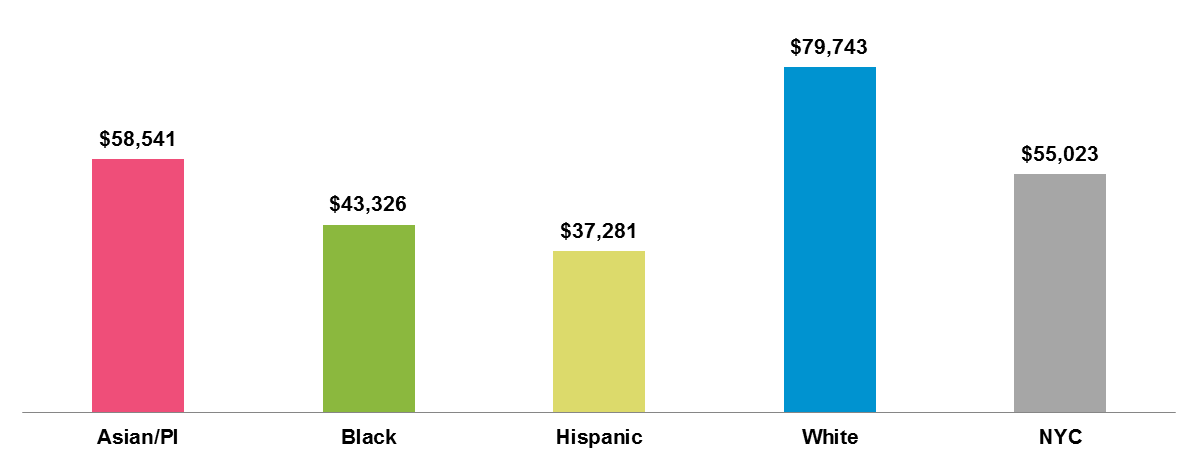
And Asians are dominating the NYC G&T program NOT because of hundreds of years of systemic racism, NOT because Asians wrote the admissions tests an inbueing cultural bias, and NOT by cheating or bribing admissions. And in NYC, Asians are the poorest demographic by a large margin. This makes the entire story extremely inconvenient for activists who want to say that the program is racist and discriminates against the economically disadvantaged. And yet, they somehow are able to get the entire program trashed because of racism against Asians is perfectly accepted in 2021.
Activists have no problems openly discriminating against Asians because whites, blacks and Latinos think of "Americans" as whites, blacks and Latinos. Asians are considered foreigners. So when a prestigious program is dominated by Asians, something must obviously wrong, right?
Activists have gutted admissions at Thomas Jefferson high school in Fairfax, VA, arguably the top public high school in the US because it had a high percentage of Asians. Lowell High school admissions in SF, a top 100 high school, underwent the exact same thing because of its high percentage of Asians. Now NYC is doing the same thing. At Harvard, the admissions department openly discriminates against Asians by saying they lack "courage" or less "likeable". Imagine the outrage if this happened to Blacks, but because it happened to Asians it's considered okay because Asians are unAmerican.