This brings back memories of Chunky-to-Planar conversion on the Amiga, where the Xor trick was combined with bitshifts and masking to rearrange the bits in 8 32-bit words in reasonable time.
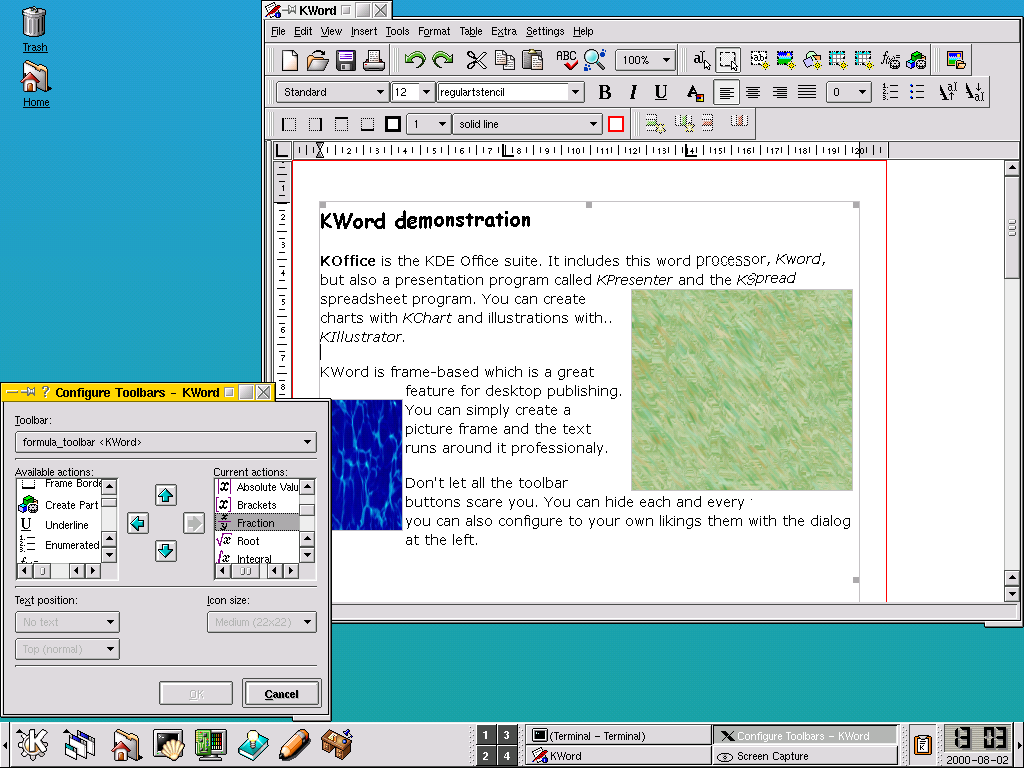
KDE1 had some very nice themes! I remember using one that drew inspiration from the visuals of Bryce on the Mac. Dark mode theme - and animated window titles which would scroll gently if the window title was too long to fit.
My memory wasn't playing tricks on me after all - Suse Linux 6.3 had KDE 1.1.2 with several nice themes [1] - I'm pretty sure the version I used back in the day was SuSE 7 (a boxed copy, bought from Staples!)
Ah, perhaps I should have said "styles" rather than "themes"! I was thinking of the look-and-feel of the widgets, not the colors and window decorations. The widgets in all those screenshots seem to use Qt's Windows style.
> KDE's sophisticated theme support starts with Qt's style engine, which permits developers and artists to create their own widget designs. KDE 2.0 ships with over 14 of these styles, some of which emulate the look of various operating systems, and additionally does an excellent job of importing themes from GTK and GNOME.
I'm sure it was version 1.something that had the Bryce theme - I remember being annoyed that the scrolling title feature had disappeared when KDE2 came out.
But it's always possible that my memory's playing tricks on me.
> Surely the person doing so would be responsible for doing so, but are they doing anything wrong?
You're perfectly at liberty to relicense public domain code if you wish.
The only thing you can't do is enforce the new license against people who obtain the code independently - either from the same source you did, or from a different source that doesn't carry your license.
This is correct, and it's not limited to code. I can take the story of Cinderella, create something new out of it, copyright my new work, but Cinderella remains public domain for someone else to do something with.
If I use public domain code in a project under a license, the whole work remains under the license, but not the public domain code.
If someone else uses your exact same prompt to generate the exact same code, can you claim copyright infringement against them? If the output is possible to copyright, then you could claim their prompt is infringement (just like if it reproduced Harry Potter). If it isn’t copyrightable, then the kernel would not have legal standing to enforce the GPL on those lines of code against any future AI reproduction of them. The developers might need to show that the code is licensed under GPL and only GPL, otherwise there is the possibility the same original contributor (eg the AI) did permit the copy. The GPL is an imposed restriction on what the kernel can legally do with any code contributions. That seems legally complicated for some projects—probably not the kernel with the large amount of pre-AI code, but maybe it spells trouble for smaller newer projects if they want to sue over infringement. IANAL.
> If someone else uses your exact same prompt to generate the exact same code, can you claim copyright infringement against them?
No, because they've independently obtained it from the same source that you did, so their copy is "upstream" of your imposing of a new license.
Realistically, adding a license to public domain work is only really meaningful when you've used it as a starting point for something else, and want to apply your license to the derivative work.
Copyright law forbids the creation of derivative works (excepting any region-specific fair-use rules) so you're only allowed to create them under the rights granted to you in the terms of the license - thus under this particular license you can't make commercial use of derivative works.
But is a physical item a derivative work of it's technical specifications?
If the design files qualify for copyright protections, then modifications to them would clearly be derivative works.
I don't think it is clear if the keyboard itself would be a derivative work, as it almost certainly can't be protected by copyright. This is what patents are for.
The design files don't qualify for copyright protections, they describe the design which (maybe) qualifies for copyright protections.[0]
The artistic design of a specific keyboard can certainly be copyrighted, but not the functional nature of it.
[0]The exact wording might be protected, but not the factual information contained. Sports scores, or say measurements of a keyboard, are not copyrightable items as they are just facts, though their presentation might be.
The results are impressive, but for the vast, vast majority of applications the actual speedup achieved is basically meaningless since it only applies to a tiny fraction of memory accesses.
For the use case Laurie mentioned - i.e. high-frequency trading - then yes, absolutely, it's valuable (if you accept that a technology which doesn't actually achieve anything beyond transmuting energy into money is truly valuable).
For the rest of us, the last thing the world needs is a new way to waste memory, especially given its current availability!
> A QR (or barcode) library is exactly the type of thing I’d assume would still work fine, since there’s nothing new to do, the parsing rules don’t change, it’s a static, known, solved problem.
I agree with you - and yet the barcode library I used recently for a variable-data-printing project was last updated 13 hours ago, despite having been around since 2008!
> And people throw out things instead of repairing them because they don't know how.
Part of it is the materials used now, though - many things get thrown out because the plastic bodyshell got old and brittle, and broke. (Plastic is particularly difficult to repair because the break usually presents very little surface area for glueing.)
PostSscript files came from the same company in the 80's
-Adobe- and with GhostScript and zmachine.ps you can play Zork I-III, Calypso, Tristam Island and the rest of propietary Infocom text adventures on it with ease.
What zmachine.ps does is to emulate the ZMachine VM in PostScript and display the output to stdout/console.
And if it werent for the PS stack limitations for sure you could emulate Linux under Risc-V.
Heck, you can emulate old RISC Linux' syscalls (enough to run static binaries) in Perl without ever calling to C bindings, not even once.
> Just like Doom-in-a-PDF, this is in equal measure incredibly impressive and utterly horrifying that it's possible.
Yes but at the same time we now have options... For example it's now totally possible to do the following:
    - intercept any PDF downloaded
    - send it to a sandboxed app before opening
    - open it from withing the sandbox
    - headlessly screenshot every page to images
    - pull the pictures (one per page) out of the sandbox
    - reconstruct a similar PDF from the pictures
It's not hard and it can literally be vibe coded in a few prompts (because it's really not hard).
Some people are going to say: "But PDFs aren't supposed to be PICTURES, it has to be searchable, so we want our Turing-complete, exploits-ridden, 2 GB big PDF readers running as admin/root and we insist, we repeat INSIST, to have our ability to open any unkown PDF from any proprietary PDF readers for that is the way!".
Thing is: we know have tool that can extract text from pictures too and they work perfectly fine.
So, yup, the surface attack PDFs have is utterly horrifying but we're already at a point where we can just honey-badge any potentially evil PDF into a well-behaving one.
I have an eMachines-branded PS/2 keyboard within easy reach, which I rescued when a colleague was throwing out an old PC. It's only a rubber dome board, but it's one of the best feeling rubber dome boards I've ever encountered!
10 years ago, a non-technical friend gifted me an eMachines tower that no one bought from his uncle's estate sale. I loaded with ubuntu server, racked it up and ran a business off of it, storing some backups, generating 500+ daily customer-requested database reports, and generally kept the CPU busy running batch jobs, builds in docker, etc. I kept it running on a UPS for years until the hard drive errors force the kernel to mount it r/o. I might have kept it going, but I had a replacement on standby.
It's replacement is another cast-off, uses less electricity and is much more capable, despite not qualifying to run windows 11.


reply