DO was unduly spooked by an empty legal threat. This was not a DMCA notice, this was a trademark notice. Parodies are protected under trademark law. Bad form taking down even a single page, and terrible form taking down an entire service.
I've listened to Sam Harris' stuff too not long ago and I'm not sure if it changed my life, but it definitely blew my mind and is part of a broader interest in this type of stuff that is changing my life. I don't agree with all his opinions, but his interview with Tim Ferriss and his book Waking Up are both fantastic.
Harris was initially my least favorite of the Four Horsemen -- Richard Dawkins, Christopher Hitchens, Sam Harris, and Daniel Dennett -- but my opinion has completely changed over the last year. With Hitchens gone, he's playing the role of public intellectual better than anybody else I'm aware of right now. I highly recommend his podcast.
I was able to make it through about half of that before the irrelevant mewling about "privileged powerful male elites in U.S. society" became too much for me.
If anybody is interested in what Harris actually had to say, they should go read it for themselves:
Under this interpretation, wouldn't (say) a collection of Facebook photos with statues, in aggregate, constitute a database and therefore become illegal? At what point does the size and structure of a collection become sufficient to cross the legal line? Would an individual Facebook user therefore be liable? Would Facebook as whole? etc.
It seems that the law has created the unintended consequence that the organization of the depictions in question matter more than the actual depictions themselves. Or in other words, of imputing commercial intent to any such collection of copyrighted works, whether intentional or otherwise.
Maybe I'm misinterpreting it, but it sounds like there's no problem since Facebook is a commercial enterprise. The problem is when a nonprofit does it. (Which seems... wrongheaded, to basically ban nonprofit websites from competing with for-profit ones.)
Publishers are allowed to make guidebooks and sell postcards without permission and also without recompense for the artists.
Historians and critics are allowed to include the photos in books without permission.
For-profit corporations are allowed to use the photos as long as they don't collect them into a single database marked "highly dangerous public database of art photographs".
But nonprofits who create a digital guidebook are copyright criminals - with the implication that they're not allowed to distribute the work for free, because it might affect the profitability of a hypothetical not-yet-existent commercial alternative.
I'd hope a good lawyer could sail a battleship through that line of argument. It's clearly prejudicial, discriminatory, inconsistent, arbitrary, and not in the interests of either the public or the copyright holders.
I suspect if it gets taken to the EU Courts, it will be shot down in flames in short order.
You might be surprised. In the end, Google got fined in France because Google Maps was competing with paid maps, and if you think about it, google maps is just a depiction of land, it's all publicly available information. But they got fined because their free product was making commercial ones impossible or very hard to sell.
Court is fine, but in the meantime, I'd just find a loophole.
E.g. it might be ok to take a picture of each piece of art with a person standing in front of it, so retake the pictures or just superimpose a picture of a person with a transparent background onto each picture.
Then once you've found that loophole, exploit the heck of it and sell prints on the street with that person superimposed on the art. Just give a big middle finger to the law.
As I understood it, the way they formulated the ruling says that it only becomes a problem when it reaches "commercial proportion", or "commercial value". According to the ruling it would be illegal for Facebook to do a similar database, the difference here being that Facebook is not creating such a database, and afaik no single Facebook user has attempted it either.
However I'm interested in what the case is with Google Ingress and their effort to make public art etc. more accessible through a smartphone-game using GPS and images.
Facebook already is one fricking giant database because it's searchable. Go ahead, try searching for "Branting Monument" on Facebook, it's a statue in Sweden.
Did anyone else notice the weird GNU/Linux screed on line 803? In particular, the "Additional Comments" content is actually written with a large amount of look-alike Unicode. Playing around with this data in Excel somehow byte-shifted it into garbage. I noticed that other folks thought it would be funny to put things like =SUM(G1:G1000) in other cells, but this seems a little bit more sinister for some reason. Anyone savvy enough in UTF-8 to deduce what's going on there?
I don't see anything weird (except that it's a useless entry). The Additional Comments column has a long quote by Stallman starting "I'd like to interject for a moment..."
Depending on the system you use to view the text, many of the characters are actually printed using non-Roman lookalike characters that still render as the "usual" ones.
In OSX / Firefox I see the usual text in the web view, but in source view there's a variation in shading between characters, in what should be an unadorned monospaced font. Viewing the same source in Chrome shows the trick for what it is...
Subtle and not always visible due to differences in display normalization in various libraries? Way out of my depth for system fonts / encoding issues. But hopefully the above shows what I'm talking about. Could there be some data hidden in the lookalike string values?
I know I personally prefer (cosmetic benefit) of not loosing a tooth. Out of several people I know who have had root canals, all have been happy with the result...
Disclaimer: All have been upper middle income with relatively good dental insurance in the US.
And root canals can be fixed, and re-fixed, and re-re-fixed multiple times if things happen to go wrong. None of the alternatives we have so far come close to a natural tooth, even if it's just a crowned dead root stump.
The reason implants suck is that they don't have a peridontal ligament, instead they're rigidly attached to the bone. This means all kinds of issues like bone resorption due to non-absorbed shocks, lack of an natural immune barrier, poor proprioception.
I've done a whole lot of individual research in the last two months, consulted with two dentists and an endo, gotten opinions from friends and family etc... seeing that any procedure is irreversible, it seems prudent to take the least drastic option first. I don't have a particular concern about recurrent infection in this case, because my diagnosis is about trauma, not decay. What concerns do you have?
Assuming for a minute that bottled air is a viable solution to smog, it's only the prestige of "exotic Canadian air" that necessitates the long shipping distance. Bottling filtered air from a relatively local source might work... but only if your factory could generate net negative emissions.
And anyhow, to have a health impact, we're talking about large quantity concentrators for those lug-around supplemental oxygen machines. These look awfully small to have any impact long term:
Anecdotal: I once tried purchasing a similar Oxygen can at a high-altitude ski resort as a sort of "stamina inhaler" on a heavy powder day. A good puff would return one's breath to normal pretty quickly, but the can ran out after a few hours of occasional use. So, at best these can be used as an ersatz, non-medical inhaler.
On the other hand, the market for air filters is still booming.
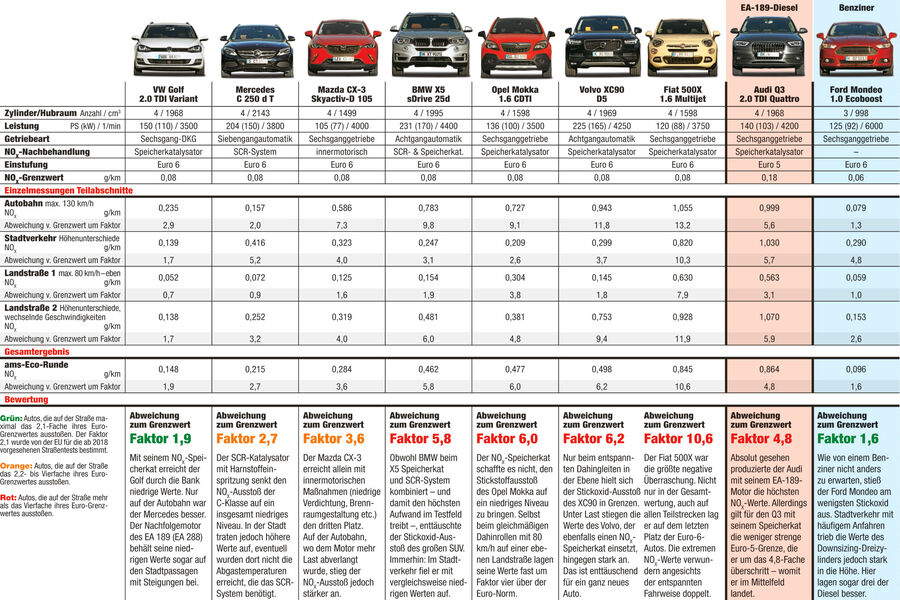
At the top of the NOx scale we have a VW TDI engine (albeit in an Audi Quatro application).
Near the bottom of the NOx scale we have... a VW TDI engine.
In other words, VW already had the capability to eliminate the emissions through design, but chose to cheat the tests instead. That is rather damning evidence, and serves as a rebuttal for those who think that VW is somehow being unfairly targeted.
Clearly, many other companies also need to lower their emissions, and regulators need to adopt meaningful tests. But to cheat the tests that do exist, and for no clear need (except possibly profit margins) is inexcusable.
What was at stake was to be able to sell into the US at all. For VW that may have been 'worth the risk', I think retrospectively they're happy to agree that it probably wasn't.
> If you naively extrapolate from the 2013 Pew Poll The World’s Muslims: Religion, Politics and Society (which in principle represents nations with a total Muslim population of about 1 billion), 40% of these think you should be killed for leaving Islam.
And, if you actually read the study, you find this number is 28%, not 40%.
Global median (by region or country?) vs global mean by total population, computed from the raw data in the annex combined with some population figures from wikipedia.


https://cyber.law.harvard.edu/metaschool/fisher/domain/tm.ht...