The price is set by how much providers can extract, not by their costs to provide. It's not at all obvious that a vast reduction in their cost of labour would translate to price reductions.
It's worth keeping in mind that in the U.S. the health marketplace is extremely complicated and cannot be analyzed with simple demand/supply graphs.
If Iran's 10 points become the basis of the peace, it ratifies Iran's sovereignty over the strait, at which point they can raise the price. It will be years before alternative routes devalue control of the strait, during which time Iran can siphon a lot of money out of passages taxes.
One thing I've not heard much discussion of is alternative routes. In the early days of this war there were discussions i of pipelines but it tapered off pretty fast
Pipelines are possible, but they take time to build. The pipeline would have to cross several countries (depending on what route is taken - look at a map) which makes it much harder. Will Oman even be interested in this? Saudi Arabia I guess could build a pipeline to the red sea entirely internally, every other country in the region would have to cross someone else.
Still if Iran does charge the $1/barrel of oil they are proposing expect the countries in the region to look into a pipeline. That is a lot of money and a pipeline could potentially be cheaper in the long run.
The big issue with alternative routes is that they don't really solve the problem. Ports in Oman and Yemen outside the persian gulf are still close enough to Iran to be subject to attack by drones and missiles. Saudi Arabia has invested considerably into pipelines to the Red Sea but Iranian-backed Houthis can strike there. Even if there was a safe port somewhere, the pipelines themselves would be easy targets. There's a reason no alternative route has been pursued over the decades.
The most economical option is to just invest in the military technologies to pass through the Strait. Minesweepers, missile defenses, an appropriate number of escort frigates - an appropriate naval force could most certainly escort ships through. It's just incredibly dumb to start a war with an adversary that has been threatening to close a major waterway for decades immediately after decommissioning your minesweeper fleet and while there are zero frigates in your navy.
$2MM per tanker for safe passage is an extra $100 billion a year in revenue, which is peanuts next to the world's de facto acknowledgement that Iran now has sovereign control of the Strait of Hormuz and can charge whatever it wants. The ceasefire also includes lifting all sanctions on Iran, and notably says nothing about its nuclear program, which becomes de facto acceptance of its right to continue it to its logical endpoint of Iran becoming a nuclear power.
Before this started, it was impossible to imagine that Iran could achieve all this. It's hard to how this isn't a massive win for Iran.
> to the world's de facto acknowledgement that Iran now has sovereign control of the Strait of Hormuz
That people thought the sovereign waters of a nation were not their sovereign waters absolutely blows my mind. Is it poor schooling, some kind of warped world view?
> That people thought the sovereign waters of a nation were not their sovereign waters absolutely blows my mind. Is it poor schooling, some kind of warped world view?
Because they are not? Oman clearly shares a part of it.
its also the sovereign waters of oman as well, its just oman outsources its military to the USA, who didn't have the ability to enforce its sovereignty.
But this was a know risk, and there are at least 20 years of plans, thoughts risk assessments for the Strait of Hormuz. Had the state department not fired everyone, or the DoD not fired all its strategic advisors, they'd have been able to tell the exec all of these problems.
1. $2MM is their initial demand, expect it to be negotiated down.
2. There is a lot of missing details. Most ships transiting the Hormuz are Asian. Will Iran also charge China, their ally, or will they get a discount? And countries like Pakistan and India who have been neutral to slightly Iran-leaning? Can the US even "sign" such an agreement on behalf of the world? As far as non-parties to the conflict are concerned, Iran's toll is literal highway robbery.
3. "Lifting all sanctions" is again Iran's initial negotiating position. Most likely, the final agreement will keep some sanctions.
> As far as non-parties to the conflict are concerned, Iran's toll is literal highway robbery.
Yes.
But before the US started this stupid war, everyone knew that Iran had strategic control over the strait, and Iran reasoned that if they were to impose a toll on ships passing the strait, the rest of the world would gang up and bomb the shit out of them, removing their strategic control of the strait. So it was kept open.
But now the US went in and bombed the shit out of them anyway, whereupon Iran discovered that despite that, the US wasn't able to secure the strait. What they previously feared turned out to be manageable. They can close the strait, and the cost of stopping them is much, much higher than the US, or any other country wants to bear.
So the rest of the world is choosing between joining the US' illegal fiasco of a war in Iran to help open the strait, or simply paying the comparably tiny toll the Iranians are asking for, in return for oil shipments resuming immediately. So far, everyone is choosing #2.
As a bonus, Iran has also discovered that they can break through the defences of the other gulf states and legitimately threaten their oil facilities, desalination plants, and other infrastructure. Previously, the mostly US-supplied missile defences they had was assumed to be 100% effective, but by testing it, Iran now knows that they're not.
And all of this because the US, in its hubris and arrogance, assumed Iran was as defenceless and vulnerable as Venezuela, and that it would work out splendidly like that time. Idiocy.
<< And all of this because the US, in its hubris and arrogance, assumed Iran was as defenceless and vulnerable as Venezuela, and that it would work out splendidly like that time. Idiocy.
This. It is hard to express the level of exasperation past few week brought. The move left US in a notably worse strategic position than when it began.
Just because there are no worthwhile violent means by which to stop Iran from putting a toll booth in international waters doesn't mean that it can do it at no cost.
Doing this is going to make Iran a global pariah and piss off its only ally, China, who has to pay 70% of the toll (ostensibly, unless they cut a deal).
$2m is the current toll that Iran has already successfully charged any ships it allows. It amounts to an extra $1/barrel, so it's a trivial tax in comparison to what the supply shock is causing in fluctuations. China has already paid, and will happily pay going forward if it stabilizes the supply chain.
Expect it to go higher as negotiations cement Iran's highway robbery. Which, yes, it is highway robbery, but it's robbery no one is able to stop without invading and occupying Iran to execute proper regime change... which no one, least of all the US, is stepping up to do.
The U.S. has lost all negotiating leverage. It's been demonstrated that they're unable to militarily impose their will on Iran, and they're far more sensitive to economic disruption than Iranians are--who are, as I type this, forming human shield rings around vital bridges and facilities, ready to die if the U.S. bombs them. Negotiations are, at this point, about the U.S. coming away with some face-saving outcomes.
They're happily paying it because it is a wartime toll.
Consider also the renewed impetus for pipelines on the Arabian peninsula to bypass the strait.
Consider that China has now recognized this as a point of weakness and will be finding ways to reduce or eliminate their exposure.
There is only one permanent solution to blackmail. Shelling out the extortion money is only a temporary one. Blockading international waters is super illegal.
> Consider that China has now recognized this as a point of weakness and will be finding ways to reduce or eliminate their exposure.
China has always seen its need to import oil as a weakness and has been working on solutions to that, solutions it is now very happy to export to other countries that now recognize the threat as well. This war is a huge boon to China which probably helped it avert a recession that was otherwise going to happen this year or next.
The only real shocker is that the USA (well, the MAGA crowd) refuse to see this as a weakness. We have a way to literally make the Middle East irrelevant, and yet we’ve decided to pull back on our anemic (in comparison to China) efforts in moving in that direction.
There are already pipelines in the Arabian Peninsula. None of those help - on the contrary, they are more vulnerable than tankers. The Houthis have already targeted the Saudi pipelines in the past.
The only possible solution would be underground pipelines but a.) sunk costs into existing pipelines, b.) capex needed is much higher, c.) you can't transport all of the oil and gas, or even a significant fraction of it through standard sized pipelines.
Saudi Arabia will invest into a port on the Jeddah side, that's for certain.
China has understood their dependency on seaborne oil for years and been actively working to mitigate it with EVs etc. Their electricity mix is coal, renewables and nuclear with not a lot of natural gas.
International law doesn't really exist and if it did, the US and particularly Israel have committed far worse violations (including the most taboo one of all, genocide). Redrawing some borders on a nautical chart by force is minor in comparison
So is declaring that you won't abide by the Geneva Conventions, targeting civilian infrastructure and double tapping a girls' school, but here we are at the logical conclusion of the dumbest war in centuries.
Another question is, how is Iran going to enforce this?
It doesn't seem Iran still has a navy that could board ships and force them to stop without actual violence.
What happens if a tanker decides to not pay and chance it? Will Iran sink it? That would constitute an act of war (a reprise of the war). Hard to pull off politically (even if it's easy to do technically).
Now imagine how the international community feels about the toll - “sure would be nice if Iran’s leadership was replaced so we don’t have to pay a toll for an international waterway”.
The whole situation further isolates Iran globally (they were already isolated before the war).
Now imagine how the international community feels about the US starting a war of aggression against Iran without even consulting with its allies and trading partners beforehand.
The whole situation further isolates the US globally (they were already isolated before the war due to threats of taking Greenland, making Canada the 51st state, leaving NATO, etc.).
How do you know allies and trading partners weren’t consulted? Of course they were! The US had to get overflight permission the first day.
Iran had long been a thorn in the side of Europe and the Middle East countries. There is no love lost if the US decides to attack Iran. Most US allies would welcome deposing the current Iranian regime.
The US is anything but isolated. Notice how happy Europe is now that the US is bankrolling the Ukraine war?
Don’t confuse public statements intended for local consumption with what’s happening behind the scenes. Countries will happily talk tough to keep their own people happy all the while partnering behind the scenes.
> Notice how happy Europe is now that the US is bankrolling the Ukraine war?
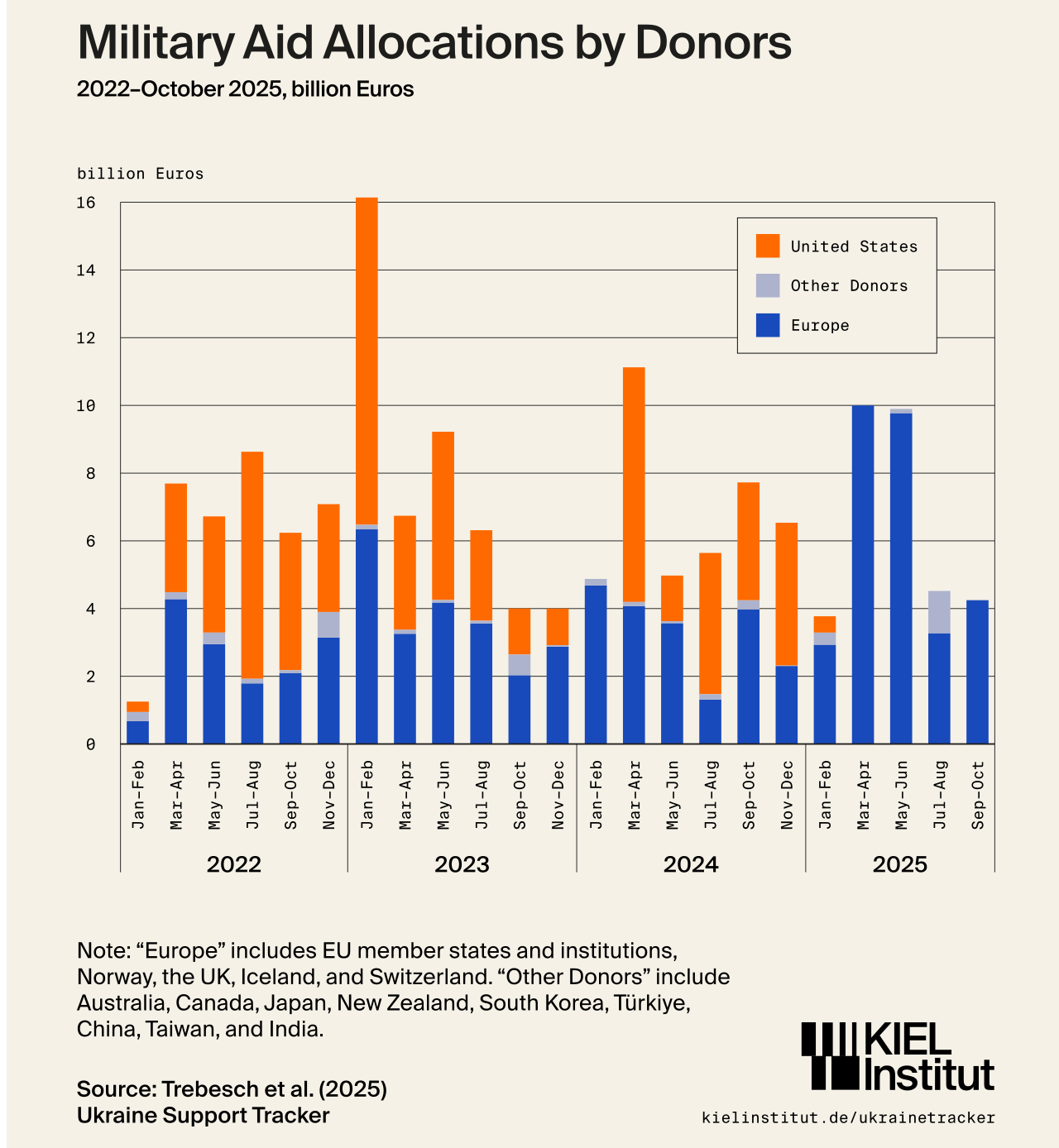
The US is not currently bankrolling Ukraine in the way it was in 2022–2024. Under Donald Trump, no new large aid packages have been approved, and support now largely consists of delivering previously authorised funds and equipment.
mopsi provided a link to data. Please at least look at it before making unsubstantiated statements. It clearly shows that the US has not contributed since the beginning of 2025, let alone 'bankrolled' it.
If you consider the topology, it is way less viable.
If you go through UAE (the narrow part) you are attempting to build a canal through mountains and desert.
Any other route (the non narrow parts) would just be 3-4x the length of the Suez Canal but through a desert, but since its not sea level the whole way, with locks (which means more water... again, desert), and at the end forces you through an even narrower strait at the end (Bab-el-Mandeb). The Houthis in Yemen have blasted Israeli-affiilated ships in that strait before, and they are Iran-backed.
Also, even if any of that were done: As ACOUP pointed out, the problem is not just the strait itself. Iran controls the entire eastern coast of the gulf and could harass ships from any location there. Even if ships could somehow bypass the strait, they'd still be in danger as long as they are in the gulf.
Essentially, Iran showed it can control most of the gulf if it wants to.
You can't cross the Arabian peninsula to the Red Sea either as there's also a mountain range on the west of it.
The only viable passage would be through the center of Oman (no mountain here) but that would be a gigantic canal. And that wouldn't really solve the issue, as the Iranians could easily block the canal as long as it is within reach of their drones and ballistic missile: you just need to hit one ship in the canal to effectively block it.
Or you could, like China did, build a massive railway from China directly to Teheran, thereby bypassing most of the maritime sanctions and maybe even transport oil directly to China:the 5 nations railway corridor https://fountainbridge.substack.com/p/china-iran-rail-corrid...
I met someone a couple years ago who was a U2 pilot (which are still in active service). He'd flown F-16s until he reached the point in the promotion ladder where flying stopped, then switched to U2s to keep being a pilot. After hitting 20 years, he was taking his retirement and training to fly Grumman S-2Ts with CAL FIRE.
Very down-to-earth guy who knew what he wanted and made his choices. Didn't at all seem like the sort to find edge-of-the-atmosphere flying a mystical experience.
1. define a requirement
2. implement the requirement
3. verify that the requirement was implemented
TDD was built around the idea that 1 and 3 could be unified in automated testing, and that's certainly true for a large part of it. But QA as a discrete role needs to exist because, beyond verifying that 2 was done correctly, they expose higher level bugs in 1, the requirements themselves.
It's virtually impossible to define requirements completely and without second order interactions that cause problems. QA is as effective at exposing assumptions and handwaving by the people who created the wireframes or the visual design as by the developers failing to test their own work.
And ideally, this leads to the cycle being virtuous: higher quality starts at the requirements phase, not the implentation phase. It's not just that QA should work closely with the engineers--the engineers need to work closely with UX and VD to ensure they fully understand the requirements. The incentives are aligned among all parties.
Imagine the poor post-doc in the back of the truck, no seatbelt, watching and noting anything going on, while the driver is doing donuts in a parking lot to really stress-test the magnetic containment.


reply