The other thing that I can't help but think has seriously hurt the industry is that, between concentrate and flavor packs, almost all supermarket orange juice tastes like garbage. Fresh-squeezed orange juice is, of course, the benchmark. If you ever taste Minute Maid back-to-back with fresh-squeezed, well, you probably won't be buying Minute Maid again any time soon. It just doesn't even taste like oranges. There are a few brands available (the expensive ones, of course) that do come close enough to actually taste like oranges, but when the mass-market product falls that far down in quality, you can't help but wonder how anyone still wants to buy it.
The process to make never concentrated orange juice logistically viable involves removing all the oxygen from the juice so it stores well. Now you can take a seasonal product like oranges and sell the juice the entire year around. Unfortunately removing the oxygen also removes most of the flavor. so what the bottlers do is add an engineered "flavor package" when they bottle the juice to add the flavor back.
I am halfway convinced that flavor wise frozen concentrated orange juice is "closer to the tree" than the "never concentrated" stuff. Nothing on fresh squeezed. But that is the price we pay to have a non-seasonal product.
As a chemical engineer we study the process for making frozen concentrate orange juice (FCOJ). IIRC you feed the juice into low pressure flash distillation that splits off most of the water. Problem is that many of the volatile compounds go out the top as well, and the resulting concentrate is blah. So you feed back in about 10% raw juice, pack the sludge in cans and freeze em.
The fun part was trying to find good estimates for viscosity for the two phase orange sludge in order to properly size the piping and pumps. Treating food products like chemical production is its own weird sub-specialty.
Salutes on the post. After hearing the flavor tricks they have to jump through to make "never concentrate" I was sort of hoping the freezing process of FCO kept more of the original flavor. But it sounds like it does not.
The industrialization of food is really what enables our modern way of life. But it slightly horrifies me every time I learn more about it.
I've always found it pretty scary how some mass-market foods have diverged almost completely from the thing they are actually representing. The weird milky vaguely-citrus flavor of chemical that comes in the box labeled "Orange Juice" is just one of many examples. For another example, go taste a grape and then taste some so-called "grape juice." It's actually mostly apple juice, and doesn't even remotely taste like grapes.
Dark grape juice is made of concord grapes which are the primary variety which is made into jelly, jam, juice, and in general grape flavored things. They don't taste like grocery store eating grapes, they're a different variety.
THEY ARE DELICIOUS when you can find them, one of the things I miss about living in California was the brief season you could get a concord grape on the vine to eat. I have never seen them outside a bay area farmer's market, late summer if I remember correctly.
I love concord grapes so much. Im eagerly awaiting their annual return to the farmers market (early September). I love them so much the vendors know to get me and tell me when they are here. I don't understand why the demand for them is small.
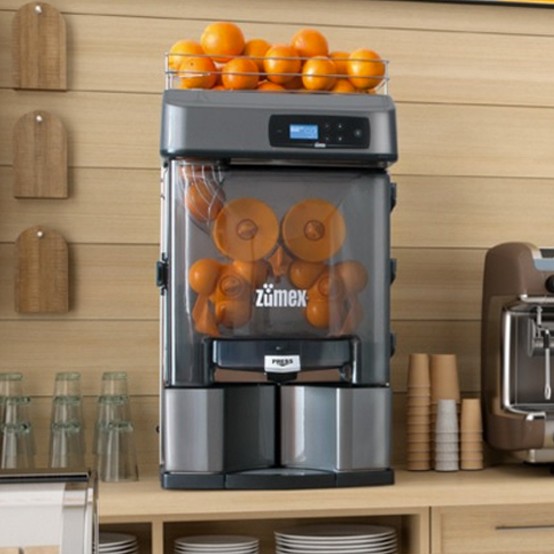
A local grocery store used to make their own fresh squeezed using a refrigerator sized stainless steel machine that might as well have been a Rube Goldberg machine with its winding metal wire chute full of oranges which led to the squeezing head. That thing was kept right in the aisle next to the refrigerator case they kept the juice in. It was the best orange juice though expensive as it was over 10 bucks a quart when the store finally closed. I tried to call and buy the machine but got nowhere. Turns out the owner died so the family closed up the shop and liquidated it.
As for Minute Maid, it has always tasted awful to me and it tasted worse in the 80s. The only packaged OJ I can stand is Tropicana.
Or you can buy a citrus juicer and make it yourself. A couple or three oranges and a few seconds in the morning.
OXO Good Grips runs about $20, it's a squeeze-by-hand option. You can get a wooden reamer, or spend about or upwards of a Franklin for something complicated, though I find simpler is saner.
I have both an old school glass dish reamer as well as a wooden reamer. Use it for making lemon/lime iced tea (using actual tea, not that powered sugar crap) for the summer months.
pretty much everywhere in the Netherlands has contraptions like this, small though, not fridge sized. Didn't see orange concentrate anywhere.
Minute maid actually tastes better than Tropicana to me (can't stand that brand), been getting one from Spain lately at Costco (Don Simon) that's pretty good, less sweet.
I have never liked Tropicana or Minute Maid, but about... 30 years ago? We used to have a brand called Fruvita that actually tasted good but it got bought by Tropicana, the taste changed, and we just stopped buying orange juice.
A Sam's Club in my area has started selling fresh squeezed orange juice. It's quite delicious. (And yes, it's pricey.) I've looked around at many other stores (including places like Whole Foods) and nobody else seems to be doing this.
It’s the boiling frog problem. Consumers gradually become used to lower quality. 15 years ago, McDonald’s was good. You knew it was bad for you but it was so good that you just didn’t care and it was a great cheat meal. You could get an Angus Delux meal for $7. https://wealthgang.com/mcdonalds-prices-throughout-the-years...
Of course they discontinued the angus burgers that actually used high quality ingredients compared to the McDouble / quarter pounders.
Now it’s $12 for a double quarter pounder meal and it tastes like shit. I only notice this because I just didn’t eat there much in the last 15 years. Meat quality and bun quality has clearly gotten worse. I don’t know how they keep growing sales.
They're insanely cheap. That's why they sell. They're cheap so the volume is there so they stay cheap.
I recall that I needed some 8-pin parts a while back to test something package-related. I looked around for the cheapest part I could find and guess what... it turned out that the 358 was the absolute lowest cost thing in the world in 8 pins. Cheaper even than dummy parts with no silicon in them.
They're cheap. They're really, really, really cheap. I once tried to design out a quad 741 a colleague had put in, because I didn't like seeing a 741-type in a modern design.
I ended up with the exact same ultimate performance and a higher cost and supply chain risk.
I don't laugh at 741s anymore. (At least, not until I've looked at the rest of the schematic.)
Twenty? Try forty. These things don't get chosen for performance reasons. They get chosen by:
1. Inexperienced or simply bad designers (this is real, sadly)
2. Designers minimizing cost or maximizing part availability (this is 99% of the volume these days: you just need something that does the function, and pretty much anything will do)
3. Designers who had them lying around in the parts bin when they got the circuit to work on the bench... and when it works well and cheaply you stop asking questions and ship it! (and yes the word "well" is doing some very heavy lifting there)
Also, nobody counterfeits 3904s and 741s and 324s. They're so easy to meet spec on that you can just ship them as genuine with your own label on top. A fair bit of counterfeits of other chips are 358s with fake top markings. That is the kind of cockroach these guys are!
When I taught I often thought of it as explaining in a spiral: first I must go around the concept, before I can dive in to the concept. Going around gives boundary and definition to what I'm talking about, allowing people to place it in the proper spot in their mental framework and to relate it with other nearby things. It also gives some motivation for what this thing is and why they should care. Then when that is done (and it does not take long), the details can be discussed, and they're easier to communicate because people are primed to receive them.
Most parts in most designs aren't anywhere close to being specification-critical. Specifying the 3904 is a great way to say "I need an NPN transistor here, and it doesn't really matter which one" (because, oh man, they can ship a lot of different things in that "3904" bin spec, and they do). So the "jellybeans" are often ideal choices.
When they are not, that is when the design engineer earns their pay.
And yet XP was widely mocked and hated at the time. Usually as the "Fisher-Price" OS. Personally I never cared too much, it might have been garish in places but the interface under the skin was solid enough: it got out of the way and let me do what I needed to. Likewise for the successor Aero Glass: blingy maybe, but ultimately pretty darn functional (at least by Win7, I somehow managed to skip Vista nearly entirely).
Where I drew the line was Win8: it started to get really hard to actually accomplish tasks in the OS. Win10 walked that back a bit, enough to be tolerable, then Win11 went the other way. I set up a Win11 desktop last week for the first time: what an exercise in unnecessary pain. (And Windows Spotlight backgrounds, one of the few recent MS shove-down-your-throat features that I actually like, doesn't even work reliably and there's no way to find out why. Absolutely no way. Despite an OS with a comprehensive logging system!)
So it's really not correlated with the skin: it's about the functional bones of the UI. A gaming machine needs a functional UI. (Just like everything else!) But the skin on top of that can, and probably should, have some visual distinctiveness and flair. A spinning cube, though... perhaps that is just a little bit too twee?
> For fourteen years... nobody — nobody — knew what these circuits were actually supposed to compute.
This is utterly, utterly mind-boggling to me. Seriously no one had any curiosity to look in to these things for 14 years? I mean, I guess someone was bored somewhere along the way, but usually that sort of thing becomes an open secret... not here, I guess.
"Production-grade hardware design files... Study real CAD... Learn from how real products are built... STEP"
I'm sorry, I hate to be that guy, but while STEP files are often used as the final export to the contract manufacturer to cut the molds, or for some level of fit checking, they're not used for anything else. The real engineering that you can actually learn from is in the SolidWorks (or equivalent) part files, and you'll note that they're not offering those.
Been there, done that... one thing I cannot stress enough is that doing this is expensive. You will need a lot more money than you think you will need. Even if you think you will need a lot of money.
There are places you can spend less money than this guide suggests (Weller soldering gear is a ripoff, mediocre performance for premium prices; Amscope microscopes are surprisingly great) and places you should spend a lot more (Rigol is not great, at least go for Siglent... and you should plan to spend as much on probes as you do on oscilloscopes... and you probably then want all your oscilloscopes to be able to use those fancy probes....) but, yeah: money pit.


reply